Showing posts with label Plotter. Show all posts

My Process for Writing (Z Minor)

Doesn’t matter if it is a short story or a novel – they all start with an idea. Some ideas are big like an historical fact or could be just a couple of words. Anything to start me thinking of characters, plots, and what if.

Once I take the idea I start thinking title. I have to have a working title, I think it keeps me grounded in the story. I must admit the title usually doesn’t change over time it takes to write the story – be it years, months or just weeks. In some ways I believe the title is most important as it can draw readers to your finished book.

After the title comes the characters, big and small. I heard one teacher call them fat characters - very developed, and skinny characters - they come on to the page and go off without much fanfare. Names of my main characters I have to have before I start writing. Other characters names I find as I write them into my story. I get names from phone books, there still is a use for phone directories besides being a great door stop. I also use magazines and baby books names. I have a good assortment, some even tell the origin of the first name and what nationality they are from. Last names I find in phone books or sometimes I find them looking at the assortment of books in my office. Many times I might not even need a last name, it all depends on the story line.

I also do an in-depth interview of my main characters before I start writing. I want to know something about them and their lives up to the point the story starts. Gives me ideas as to how they would react under certain circumstances. I ask about their families, what they like or don’t like. What is their pet peeve? - you can bet whatever it is will find its way into the story one way or another.


I usually write two to three chapters to see if I think I have a good work in progress. If so, I write the first draft straight through. By the end of the book I really know my characters and how they reacted to the plot etc. I go back and start the rewrite process and many times I use information found in the later chapters to flesh out the story more and in the process it can give it more depth. I have also started to do a little more plotting with the rewrite. I make sure all the loose ends are tied up, is the plot believable, and add anything that seems to move the story to a strong conclusion. All this works for me. Best of luck with your writing.  

Z. Minor
Author of Historical Romantic & Contemporary Suspense Novels

Rinse, Wash, Repeat

I have to laugh at this month's blog subject: The Writing Process. Most of us don't think of our writing as a process. We simply write. But if I step back and give it a little more thought, each of us does have a particular way we do our writing, better known as a process. And like so many other things in life, that process is unique to each of us.

Writing doesn't come easy.  It should, shouldn't it?  It looks easy.  Just put some words on a paper that make sense, a voila! A story!

Oh, how I wish it were that easy!!

So we each create a process to get us from Point A (the first glimmer of a story idea) to Point E (for End as in the End of the Finished Book).  It can take years to get a complete process, and even then, it manages to need some changing at times.  A little tweaking to make it better or get through a particularly rough spot.

I'm a plotter.  I wasn't always a plotter.  In fact, some years ago, if anyone even suggested I might want to try plotting, I would put my fingers in my ears and La la la la la, until said person went away.  Long story, but in the end, I learned how to plot.  My way.  It isn't anyone else's way.  It isn't right or wrong, it's simply mine.

Step One: The Spark of an Idea
This first step often happens while a few chapters away from the current WIP.  Terrible timing, and it could be ignored, but I've discovered if I do that, I'm going to wish I hadn't. That spark will run and hide, and it will take every trick and prayer to drag it out of hiding.  I was lucky.  I was smart.  Why? Because I didn't ignore that spark when writing the last half of DESIGNS ON THE COWBOY.  In fact, I was several rounds into my morning walk at a local park, thinking of virtually nothing---those morning walks were for exercise and letting the brain take a rest---when a picture popped into my mind of a naked man in a pond, his back to "me" (the character and heroine, of course!). Afraid I'd lose the image before I finished my walk and went home, I burned it into my brain. The moment I walked into the house, I sat down at the computer and wrote the beginning of the opening scene.  And then the real work began.

Step Two: Decide What the Story is About and Who the Characters Are
I mean, let's face it. With a naked man in a pond, anything could happen. I had another flicker of an idea and realized that the heroine knew the naked man, although she didn't realize it at the time. Aha!  A reunion story! I needed a backstory.

Step Three: Letting the Right Side of the Brain Take Over
Sometimes it takes a little pushing, sometimes it just takes letting the imagination take over with no parameters, no rules, just ideas gone wild. Most are discarded, those special few that have some merit will be weeded out and saved.

Step Four: Putting Together a Plot
I've never completely figured this one out.  By the time I get to this step, I know and have probably written the first few pages of the story.  I have a clue what the black moment will be, and the turning point.  I also know what will be in the first three scenes aka the first chapter and then end or hook at the end of the third chapter. Everything in-between takes a lot of what-iffing, some of it good, most of it... *shrug*

Step Five: The Story is Plotted
This point could be only a few weeks after Step One or months later, depending on if the brain is work and if I'm writing to deadline on something else. But at least I know the story.  Not every detail. That comes with the real writing. But a good idea of how this story and these characters are getting from Point A to Point End.

The rest of the steps are the actual writing.  I follow the plot, which usually works out as it should, but I've had to teach myself and my characters to be flexible.

And then comes the point where the first draft is written.  The story is there, and it's time to edit. The number of edits depends on a lot of things.  How much time to I have before I have to turn this in?  How many places need to be not only tweaked but rewritten because I went off on a tangent I hadn't planned.

There's a final polish, a knot in the stomach, and a moment of panic as my finger hits the SEND key in my email program to shoot the manuscript to my editor.

And then I wait.

And I hope I have a new idea to work on, so I can stop looking at the calendar every day, waiting to hear from my editor.

That's my Process. But it's only mine AND YOU CAN'T HAVE IT. You get to create your own that fits only you. But you can borrow ideas from others and make them your own.

The final word on The Process is to tweak whenever needed...because sometimes the writing flow hits a damn, and we need a little dynamite.

The Spark that Sets My Knickers Ablaze or Lights My Way (Melissa Robbins)

Earlier in this year, dry, grassy areas caught fire along the highway in our town, sending my neighbors into a frenzy.  Neighbor helped neighbor.  Firefighters showed up to battle the fires to keep them from spreading and damaging the houses.  Children watched everything in awe. 

We asked the firefighters how the fires got started.  One said he saw sparks shooting off a trailer on the highway.  With the dry conditions and that darn Kansas wind, that’s all it took. 

“Uh, Mel.  The topic is your writing process, although we won’t complain if you start talking about hunky firemen.”  What does this have to do with my writing process?  Take that spark the fireman talked about.  If you’re panster, that spark would set your knickers ablaze and you would take off, writing like a fire frenzy.  I’m picturing Thunk (from The Croods) who thinks the fire is biting him so he runs into the tall grass and sets the entire field on fire. 

Now me, I’m a plotter.  I’ll take that spark, light a torch, and stake it into the ground.  Then I’ll circle it and to make my teachers proud, I’ll ask the Who, What, Why, When, Where, How, and the What Ifs.  Let’s go back to that fire by my house.  What if the firefighter didn’t see that trailer or what if they discovered it was arson?  What if a neighbor wanted to burn down his house for the insurance money or to cover up a murder?  My “spark” could be an incident or a character.  What if one of the homeowners was a single woman who gave a bottle of water to a fireman.  That one act of kindness could melt his cynical heart for whatever reason.  Romance!  Or one of the kids witnessed the heroism and the event reminded him of his dad who, also a fireman, died in the line of duty.  The possibilities are endless. 

I take another torch and, using the fire from the first torch, I light it.  Then, I run ahead or hop into my car and drive all the way down to the end of my story and stake that new torch into the ground.  This is where I want my story to end.  Then, I run or drive back to the first torch.  I can see the last torch.  I know it’s there.  With more torches, I start to light my way to the last torch.  First they are sporadic, spots were certain things must happen.  Some call them turning points.  I use Alexandra Sokoloff’s screenwriting method of plotting and she calls them act climaxes. 

More scenes are written.  More torches light my way.  Sometimes, characters light their own torches and go a different way.  As a writer, I have to decide if that’s good or bad.  Keep that bucket of water handy to douse any unwanted fires. 

Same goes for when I finally reach my last torch.  I may turn around and go yuck, that’s not a very pretty path of torches or my last torch is in the wrong place.  Some get extinguished altogether.  Some get moved around.  New prettier torches may take their places.  Only you know when the path of torches is complete and beautiful. 


Now go find those sparks and light up the world with your stories!  

Plotter? Pantser? How about an 80/20 hybrid? (Melissa Robbins)

I HAVE to know point A and where point B ends up so I can leave a trail of bread crumbs (clues) along the way.  I’ve read that some mystery writers can pen a story without knowing who the killer is until the end.  Nope.  Not me. 

Besides using the great plotting method by Alexandra Sokoloff (her Elements of Acts are awesome), a simple spreadsheet helps me plot out a mystery.  I list each character’s name at the top and below that, I type in his or her agenda, secrets, etc.  My first person heroine may not know what’s going on, but I have to know. 

But like the title suggests, I’m a hybrid and only too happy to follow a character who leads me in another direction.  He or she may reveal a secret I didn’t even know about!  I just have to be careful my characters don't leave me astray.


The key with writing, whether you're a plotter or a pantser, is use what works for you.  

Plot? Pants? Both? Oh My! (Penny Rader)


This month our topic is "Are you a Plotter (outliner) or a Panster (seat-of-the-pants) writer?  Why?" 


Bing image
Plotting doesn't come easily to me, so I went trolling online for some help.  Below are snippets from articles that intrigued me.  I urge you to click on the hyperlinks and read the articles.  They are chock full of great ideas.

 Also, if any of these are helpful to you, print them or save them.  You never know when something will disappear online.  An article I planned to use for this post was available two days ago, but not today.


The 8 C’s of Plotting: Worksheets (Lara Willard)

  • Captivation
  • Change
  • Complication
  • Confrontation
  • Collapse
  • Comprehension
  • Curve ball
  • Culmination


A Date with Kate – Plotting (Kate Walker)
Bing image

Training Yourself as a Plotter

  • Read Read Read – learn the plots that make successful romances in the past and in the present – and the ones that have failed.
  • Watch soaps/dramas/films – stop it halfway – or at the end of the episode – ask yourself: Where is it going? Who will end up with whom? 
  • Read newspapers/magazines/watch people stories on TV – use them as your characters - see if you can see what will happen – check it against reality.
  • How could you rework a fairy story?
  • With every story you read, watch, hear - think about what was behind it, who is involved, why it happened - and consider what will happen next. 


The Great Debate: Plotting Versus Pantsing (DB Jackson)

First, let me say this:  Each writer has to find his or her own way.  Between the extremes of no advanced plotting whatsoever and outlining down to the most minute detail, lies a broad spectrum of possible approaches….

Second, that spectrum I mentioned really does provide a myriad of possible approaches.  I think there are few writers out there who are pure pantsers or pure plotters.

And third, the term “organic” means different things to different people.  I believe that on some level ALL writing is organic.

Finally, allow me to say this:  I think that for aspiring writers especially, some level of plot outlining makes sense.


How Plotting & Pantsering Affects Everything You Write, Pt 1 (Vince Moore)

Pantsering and plotting are similar to being left or right handed. Each person tends to favor a dominate hand and yet each individual also tends to make ample use of both hands.

Types of Pantsers and Plotters:

  • Type I Plotter: this is a writer who was born a plotter. This writer may even think plotting is the only way to write. 
  • Type II Adult-onset Plotter: this I believe is the most common type of plotter. Most Type II’s have tried pantsering and can’t make it work. 
  • Type I Pantser: I think almost all pantsers are lifelong type I’s. I have yet to meet a pantser who was once a plotter but had to give it up
  • The Plotting Pantser: this is a pantser who may be ‘passing as a plotter’. She keeps changing the plot as new ideas arise with almost every chapter.
  • The Pantsering Plotter: this is a plotter who may be passing as a pantser. She starts writing without a plot in true pantsering fashion but then keeps building a plot on the back end of whatever she has written.


How to Write a Book ( OJ Omololu)

9 Steps for Plotting Fiction (Taken from the Verla Kay Message Boards)

  1. Triggering event
  2. Characterization
  3. First major turning point
  4. Exposition
  5. Connect the dots
  6. Negative turning point
  7. Antagonist wins
  8. Revelation
  9. Protagonist wins


Nanowrimo Prep: The Index Card Method and Story Structure Grid (Alexandra Sokoloff)
Bing image

Make two blank structure grids, one for the movie you have chosen from your master list to analyze, and one for your WIP (Work In Progress). You can just do a structure grid on a piece of paper for the movie you’ve chosen to analyze, but also do a large corkboard or cardboard structure grid for your WIP. You can fill out one structure grid while you watch the movie you’ve chosen.

Get a pack of index cards or Post Its and write down all the scenes you know about your story, and where possible, pin them onto your WIP structure grid in approximately the place they will occur.


The Outline Dilemma—Plotting vs. Pantsing (Beth Hill)

Plotters

  • Plotters can write character-driven or plot-driven stories.
  • It’s quite likely that plotters know the story’s ending.
  • A lot of plotting is imagining what if.

Pantsers

  • The pantsers often just begin writing with the smallest kernel of a plot or with only the shadow of a character that snares their interest.
  • If you’ve got sticky notes posted as reminders on every surface of your office, you’re probably a pantser.
  • Pantsers may actually have more notes in the margins of their manuscripts than plotters will (since plotters keep their notes in the outline)...
  • Pantsers...may face plot tangles after writing the first draft that the plotter doesn’t face 
  • Pantsers also enjoy the excitement and enthusiasm of putting story to paper without first hashing through the story.

...there is no right method.

You’re the writer. Use your tools in ways that make you succeed.


Planners Versus Pantsers (Suzanne Church)
Bing image

I've tried both techniques. I tend to write short fiction as a pantser and novels as a planner.

In my opinion, two books on planning and analyzing plot and structure are particularly helpful for Planners. Writing the Breakout Novel Workbook by Donald Maass and Save the Cat by Blake Snyder.

… my favorite planning tool…Excel to create a multi-worksheet planning file.  … Essentially my spreadsheet is my bible (or codex if you prefer) and can be especially helpful if I need to set the novel aside for a while.


Plotter or Pantser: The Best of Both Worlds (Cindi Myers)

By now you’ve probably identified yourself as either a plotter or a pantser. Whichever approach works for you, I’m convinced you can learn from writers who take a different approach.

If you’re a plotter, try flying by the seat of your pants. Maybe not for a whole book. But every once in a while... Ask your characters to tell you what they’re going to do next.

If you’re a pantser, try plotting out a chapter, then writing it. See if it helps you write more quickly or more easily. Experiment. See if thinking about your book as a whole at the beginning of the process helps shorten the rewriting phase.

There’s no one way that’s right or wrong. The important thing is to write the book. It doesn’t really matter how you get there. But don’t be afraid to experiment with writing methods as a way to challenge yourself and keep your creativity fresh.


Plotters, Pantser,and Percolators (Karyn Henley)

I've discovered that I’m more of a Percolator. Percolating is a mixture of pantsing and a plotting. Here’s how it works for me: I dedicate a composition book to the project I’m starting. Then I go through Donald Maass’s Writing 21st Century Fiction or his Breakout Novel Workbook, both of which ask thought-stimulating questions that I apply to my specific story. I let my story idea percolate through each question, and I jot answers in my comp book. Without fail, I discover characters and motivation, see possible scenes, hear dialogue, and so on.


Story Planning Worksheets (Jami Gold)

Jami has lots of great worksheets.  You’ll have to go to her page to access these:

  • Blake Snyder’s Save the Cat Beat Sheet (plot arc oriented)
  • Larry Brooks’s Story Engineering Beat Sheet (plot arc oriented)
  • Master Beat Sheet Combining Save the Cat and Story Engineering (plot arc oriented)
  • Jami Gold’s Basic Beat Sheet (plot arc oriented and stripped down to basics)
  • Jami Gold’s Scrivener Template for the Basic Beat Sheet
  • Michael Hauge’s Six Stage Plot Structure Beat Sheet (character arc oriented)
  • Jami Gold’s Romance Beat Sheet (romance arc oriented)
  • Jami Gold’s Elements of a Good Scene Checklist
  • Jami Gold’s Elements of a Good Scene Worksheet


To Plot Or Not To Plot…That Is The Question (Destiny)

Are You A Pantser?

  1. Do you commence a new novel based solely on an idea, character or sentence?
  2. Do you often say, “I let the book tell me where it’s going.”?
  3. Do you view writing as taking a road trip with only a vague destination in mind?

Are You a Plotter?

  1. Do you get inspired and then write an outline?
  2. Do you get giddy doing chapter summaries?
  3. Does the thought of not knowing whether your character is a mustard or mayo person make you anxious?

…there is no wrong or right way to write you novel. The bottom line is you have to write it! Whatever methods you take to get to that finish line is the right way for you.

Bing image


The Ultimate Plotting Tool for Pantsers: Your Novel in 9 Sentences (Joel D Canfield)

A tool he learned from Larry Brooks…stating each of these in a single sentence will give you a clear easy-to-follow path through your novel.

  1. The Hook
  2. The Setup
  3. The First Plot Point
  4. Response (including First Pinch Point)
  5. The Midpoint
  6. Attack (including Second Pinch Point)
  7. The Second Plot Point (including the “All is Lost” Moment)
  8. Climax
  9. Resolution

~~~

Did you find any of these helpful?  Are you a plotter, a pantser, or a combination of both?

Plotter or Pantser? Why? by J Vincent


Plotting a story, that is outlining it, is one way for a writer to get the tale they want to tell to take shape.  This involves imaging the action from the beginning to end and in some detail.  Not only are chapters sketched out chapter by chapter but at times scene by scene. 

A Pantser, as in “by the seat of your pants,” envisions the whole story in general, or at least the beginning and the end but not very many details. In this method the writer lets the characters tell the story their way with their details.

Both methods work albeit, better for some writers than others.  This week I read an article in which a scientist studied the connections of cells in the brain.  He stated that these connections are the identity of the person.  I believe how your brain is wired will determine how you end up writing.

When I first started writing I outlined in detail.  Chapter and verse, so to speak.  Outline before me, I would start typing (yes, typing not keying) my story.  It would usually go fine for a chapter or two and then one of the major characters would throw a spanner in the works.  (I HAVE been watching and reading too much British writing!) The spanner, that is wrench, became apparent to me when I could not get the story to go forward no matter how hard I tried.  At that point I usually rethought and reworked my outline and then continued until another spanner came along.

This became very tiresome.  I was losing writing time redoing the book outline.  So I became a pantser.  If the characters wanted to tell the story, fine.  I’d envision the beginning, perhaps a few scenes along the way, and that the hero would get the heroine or visa versa at the end.  This done I would write.  I remember The Curious Rogue especially as it wrote itself in six weeks. I was frantically typing away that last week because I was more than curious to learn the ending.  I knew the hero would get the heroine but not how. I also decided I was mildly insane.  How on earth could characters I created with a story I saw in my mind write their own story?  This was before WARA, before I knew any other writers.  You can’t know how relieved I was to learn this was not an isolated event but something that happened with other writers also.  It has happened to me several times.  I wrote the last half of Honour’s Redemption in two weeks.  If something works I tend to stay with it.

So which am I—plotter or pantser?  I’m my own version of a combination of both.  Partially by nature and partially by chance.  It is a lot like asking “Why am I a writer?”  I can give some reasonable explanations for why I became a writer but in the end I think it has more to do with how my brain is wired than anything.  Heredity and environment—that’s why I write the way I do.  How about you?

What the &%^$$ is a Story Bible?

Small shelf of current WIP bibles
CONFESSION TIME

I'm a plotter.  I didn't start out that way, but as I continued to write, my critique partners/writing buddies told me I must learn to plot.  Yeah.  Sure.  Right.  Me plot?

But their reasoning was that once I sold a book or two, I'd need to be able to write a full synopsis.  I thought that if I knew what would happen in the story, it would totally ruin the fun of writing.  Those CPs were ruthless, and so I learned to plot.  Now I can't write without plotting. ☺

I'm visual.  I wish I would have known that in high school.  It might have saved a lot of hours...days...weeks.  But now that I know it, not to mention that the memory of something I thought of two minutes ago can vanish into thin air, I've become aware that if I don't write it down and keep it somewhere, a thought, an idea, a name, a conversation/dialogue between characters can be gone in a the blink of an eye.

I didn't start out building a bible.  I didn't even know there was such a thing.  Now I know that a lot of writers make them and use them.  Do a search on the internet for *how to build a story bible* and see how many articles are available.

The key to a bible is how you put it together.  Sue's won't look like Jane's.  Ann's won't look like Sue's.  It's an individual "thang" when building a bible.  You make and use what you need.  Pick and choose what works best for you.

My method is to use a 3" binder.  I started using white, but I've found that using a different color for different genres works well, too.  If I'd known I'd be writing a 10-book series, I might have chosen a special color for it.  I didn't, so all 11 binders are white.  (One for each book and a separate for the series.)

Outside front of bible
Like Penny and Melissa, I use pictures to start.  One of the hero, one of the heroine, and one each of a child or pet or whatever is needed.  I use my B&W printer to print them--no need for color.  Those are in a file on my computer. I slip the photo of the main characters into the front of the binder.  In the photo on the right, you can't see the photos, but there's a method to my madness.  Because I only plot the main idea of each scene, I don't know exactly what is going to happen, so as I'm writing and realize I need to change something in previous scenes that are written, I use sticky notes and put them on the front of the binder.  I also keep track (upper right of photo) of how many words and pages I've written, both by scene and chapter, and by date.

Heroine & Hero
Inside the binder, I use sheet protectors on the things I use the most.  The order in which I place them isn't always the same, but the basics are...until I realize I need to add something new.

Characters are the most important thing in a story, both who they are and what they look like.  (Harlequin likes us to send pictures of well-known people for our cover ideas.)  There are many places to find pictures for characters.  Modeling websites, photo sites (do a web search), even Pinterest are helpful.


Character List

Next comes a complete list of character names, starting with the hero and heroine and including the names of any characters that appear in the book or are mentioned by name.  After having to hunt for the name of the waitress at the local cafe, who appears randomly throughout the series, or the parents who were mentioned by name, but never appeared, I decided everyone with a name was needed, after all.  If a new character appears, the name and who they are (related to hero/heroine or minor character, even if only mentioned), that character goes on the list.


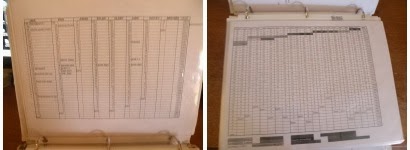
It helps to know the ages of each of the main characters, their children, brothers and sisters, and babies born that are relevant, so I create an age chart for each book (below left).  The first year at the top (in the right column of the graph) is the year in which the book takes place, then drops by each year, until the oldest character is born.  There's enough room to put a few words for something such as "moved to Desperation" or "Graduated high school," anything that might be a major event in time that appears as backstory in the book.  If it's a book within a series, I have a chart with the main characters' ages in all the books.  If there are children, those ages are listed, too. (below right)
Age charts story and Series Main Characters
Then comes the plotting.  While I do the original plotting on a big white board, I like to have a portable copy I can take along or have at hand to look at as I write.  I also create a calendar that has the scene on the date it takes place (one page per month).  It helps me know how time is progressing throughout the story, and I don't have to hunt for how long it's been since something has happened...or will happen.
Small storyboard and Calendar of Scenes


Another handy tool is to have a calendar of a full year.  I found a great place online that has a printable calendar that goes back in time and goes forward a few years, too.  Another aid in plotting is a timeline, which comes in handy with the full year calendar when working through the story calendar.  The timeline includes time of day.  It helps when plotting forward to see if all makes sense, before using the monthly calendar.
Full year calendar and Timeline
I've always loved looking at house designs and house plans.  When many scenes will take place in a particular place, such as a house, I look for a plan that will suit my character.  Why?  Without a "map," I get lost and forget if the kitchen is to the left or the right, or even where the staircase is located.  It's like playing with a dollhouse on paper. ☺  Because the setting of the series is based on the layout of the area around the town where I spent my junior high and high school years, I pulled up Google Maps and have several aerial shots.  Three of the books in the series involve two brothers and a sister.  A little mini-series within a series.  The house of the hero in DESIGNS ON THE COWBOY (June 2013) is modeled after my great-aunt and great-uncle's house, a Victorian built in the late 1800s.  I had to go by memory on the inside, but for the farm/ranch, itself, an aerial view helped with the outbuildings, roads, and more.  This house and surrounding area play a big part in my upcoming August book (the sister), and a neighbor's house, which really isn't there.  I added squares of paper to show where the house, barn, a large pond, and other things were located on the hero's property.
House plan and photo, with aerial shot of the layout of the land
Last but not least for the August book, I kept getting myself turned around in the area around the hero's ranch house, so I created my own little map, so I would know what the characters would see and how they would get to where they were going. (on left)  The photo on the right is my working calendar.  I began it about halfway through the series.  It helps me keep on deadline and get things done when they need to be done to beat that deadline. ☺
Layout of ranch yard and My Working Calendar
All of the above--and sometimes more--are kept in protective sleeves in the front of the binder, now a story bible.  Behind them are tabs for each printed chapter.  Again, for portability.  I often work while waiting to pick up grandkids from school.  Nearly everything for writing the story is in the bible.  Some have more information from research I've done, most don't have aerials or ranch "maps."  If I think I might need something, I'll add it.  Pockets in front and back of the binder are handy for extras, such as scribbled notes or ideas for later.

For more information on Story Bibles, check out Taming the Series Beast on my author blog.  There are also links there for information on how other writers create their bibles.

So there it is.  My method of keeping track.  While I'd never dreamed of writing a 10-book series, the first two books grew into more new books, and I'm thankful I'd already begun to keep a bible for each book.  To keep all the major series information and a complete list of all characters (even those mentioned) and a complete age chart, who they are and what books they appear in, I use a 1/2" binder.

Remember, if you decide to create a story bible, do it your way.  Mine is only one of many.

Are you completely confused?  Overwhelmed?  That's okay.  It's done little by little.  For more details, you can give me a shout in the comments.  There are always little tricks to make it easier.

Oh, and HAPPY THANKSGIVING!!!  (We're having our turkey day tomorrow.)

My Top Five Tools for Writing (Melissa Robbins)

There are so many stages of writing with different tools helping in each stage.   Here are my top five.

Plotting Board –  When I wrote in my teen years, I didn’t plot, so my stories eventually failed.  Now, with my plotting board, I can move around scene cards and see what’s missing. It’s hard to see the big picture in a word document.   I use Alexandra Sokoloff’s screenwriting techniques and her Element of Acts. 

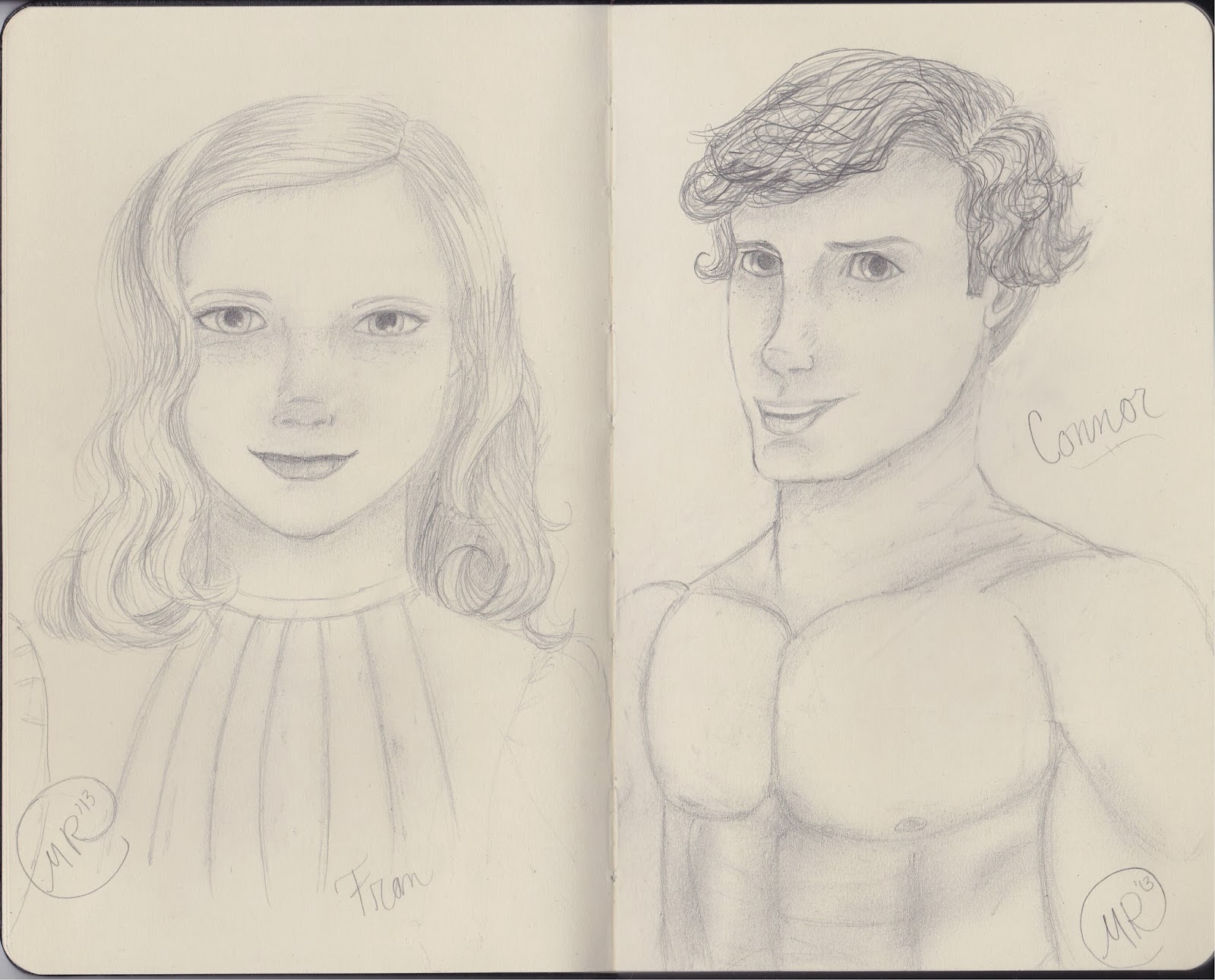
Sketching – I find if I sketch my characters, describing them comes easier and inspires me to write more.  Oddly enough, my sketching also helps my critique partners when I sketch their characters.  They see what I see.  Did they give enough detail that I could draw a scene or too much?  These sketches are Fran and Connor.  Of course, I drew Connor shirtless.  You’re welcome. 

Critique Partners – For years no one knew I liked to write, because I kept the pages hidden from everyone else including my family.  I became friends with Fran in Irish Dancing and discovered she was a writer too.  We swapped our wips and have come a long way since then.  Critique partners see the things we miss and help you when the words won’t come with encouragement or ideas. 

Spreadsheets – Wonderful invention; I have an aerodrome full of people, eight pilots in one story!  Spreadsheets allow me to keep track of all my WAAFs, pilots, RAF support personnel, and their families.  Just call me Group Officer Robbins or better yet Air Commandant Robbins (highest rank a WAAF could receive, equivalent to a Major General).  I also have family tree spreadsheets since my characters seem to hook up.  ;0) 

Lately, spreadsheets have helped me with my plot.  In mystery writing, everyone has secrets.  The key is finding out which character would kill to keep those secrets hidden.  My Agenda Spreadsheet lists my main characters, but not my first person pov character.  I always know what she is thinking, but by keeping track of the agendas of the rest of my characters, I can see where to insert clues or reveal them.


Google – I’m convinced that writers need to know a little bit about everything.  That’s probably why I earned the nickname, Queen of Useless Knowledge from my husband.  I have googled things on occasion, like the scientific name of clouds because a pilot will know that.  I guess before Google, writers spent all their time at the library.  

Do you use any of these tools? 

Mistake or Learning Experience?


There are two kinds of writers.  Plotters and Pantsers.  Plotters tend to outline their stories and follow the outline faithfully.  Pantsers on the other hand, write by the seat of their pants or in a much more freewheeling spontaneous style.  I slowly evolved from a dyed-in-the-wool plotter to a hybrid with characteristics of both styles.  That I needed to be more of a pantser (read that my characters needed me to be) was brought home like a proverbial 2x4 up side the head during the writing of the fourth book in my Honour series.  Honour’s Redemption took an eternity to write.  Well, not an eternity but it seemed that long since I ended up writing the first half twice.  How did that happen?  Was it a mistake?

I had always outlined my stories and was accustomed to my characters occasionally going their own way.  It usually wasn’t a big detour and the story followed the outline more rather than less.  Forgive a small aside here: I’ve never been able to understand or explain how the characters I create act like my children in that they do their own thing no matter how I feel about it.  I worried for my sanity until other writers mentioned having similar problems.  The end result is the same--if I don’t let my characters have their way the story will stall out and go nowhere.  When it came to Honour’s Redemption the characters evidently decided I need a writing life lesson.

After outlining Redemption I started writing.  Somewhere around Chapter Four my hero and a couple of my minor characters started objecting to the direction of the story.  I put my foot down or rather my finders to the keyboard, and wrote on ignoring their protests.  By Chapter Seven I was getting uneasy about the tone of the story.  It was dark to a degree anyway but it was taking on a more sinister rather than redemptive quality.  I still refused to listen to what my characters were whispering in my head.  This was MY story I was going to write it \MY way.  The outline or the highway.

Then in Chapter Eleven a minor character was raped.  This scene was not in my outline.  “How could this happen?” I asked in stunned horror.  I, after all, was writing the story.  The incident had nothing to do with my image of my main characters’ journeys-- physical, emotional or otherwise and I did not want this incident in my story.  And the story was dead on the monitor or perhaps more realistically completely, totally stalled in my mind.  I tried rewriting the chapter to take it another direction.  That went nowhere.  I put it aside for a week and when I came back to it I struggled until I admitted that I didn’t have a glimmer of an idea about how to fix it.  I put it aside again.

Two months later, and over 200 pages into the book, I came to the conclusion that the only way the book would get written was to throw out what I had and start over.  I bit the bullet, reread the outline, and began again.  But this time I let the characters lead the story.  I steeled my nerves and re-outlined when they got too far off the Roman numeral track.  At the mid-point of the story I heaved a huge sigh of relief.  While the tale wasn’t following MY outline it did have the tone I wanted.  Evidently the characters also decided I had learned my lesson.  I wrote the last third of that book, 130 plus pages, in less than a week.  I usually write faster when I near the end of writing a book, just like I read faster when reading a book.  I can’t wait to find out how it ends in either case.  I mean, we all know boy gets girl or vice versa but HOW?  That is what I must know.  This time the words, the scenes just flowed from my fingers like magic.  Gives me a chill just to recall it.

I still plot but I learned from my experience with Honour’s Redemption and never stand in the way of my characters for long.  Are your characters as independent as mine?  Or am I a few keys short of a keyboard?