Showing posts with label writing aids. Show all posts

My Writing Toolbox by J Vincent


My first books in the late 1970’s were all written in longhand and then typed on a manual typewriter.  My first computer was an IBM PCjr which my husband gave to me for Christmas the year I went back to teaching--along with the payment schedule. It took him 24 hours during Christmas vacation to figure out the software he also bought so I could do my grades. Have we come a long way baby since then! I’ve had a variety of computers over time.  It took me awhile before I could compose on the computer but teaching got me over that.  When I was building the computer lab at school as well as teaching in it I often had to compose lessons, assignments, and quizzes on the fly.  Suddenly it didn’t seem so strange to do everything on the keyboard! I hated Word Perfect which I had to learn to teach the school secretary but it saved my bacon when it came to teaching my students word processing on Apple IIe’s.  When what you saw wasn’t what printed I knew exactly how to fix it due to WP. When I built a networked Windows lab I switched everyone to Microsoft Word which seemed easier in comparison.  So many versions of Windows and Word since then.  I’m on Word 13 now.  I also occasionally use Dragon Naturallyspeaking.  If I were more industrious in training my “dragon”--actually me--I’d use it much more. My present laptop (no more desktops since the last one died) is an HP Envy 17”. I bought this one a couple of years ago because of ongoing vision problems--simply needed a bigger screen although I did not like the increase in size and weight at first.  

Besides Word and Dragon I have other software that assists me in my writing.
·       Family Tree Maker helps me keep all my characters ages etc. straight in the series I am writing.  Quick Verse is what I use to find or refine all the bibilical quotes one of my character’s is well known to spout as well as vicars and other characters. 
·       Webster’s Ninth New (it really was new in 1989) Collegiate Dictionary is the only one I know of that included original date of use.  This is very helpful for a historical author! 
·       I have several “name” books both first and surname.  I especially use A Dictionary of English Surnames and wish I had a French one, too.
·       Roget’s Thesaurus which I originally found extremely frustrating to use and my well-worn Reader’s Digest Family Word Finder--a layman’ thesaurus if you will.
·       A to Z Georgian London and A to Z Regency London with large detailed street maps of the times.

Many of my resources are online these days.
·       http://www.heraldica.org/topics/france/noblesse.htm gives me insight into Nobility and Titles in France
·       http://www.essentially-england.com/ is for English Lovers and all things English
·       http://archiveshub.ac.uk/index.html lest me search archives of over 250 institutions across England
·       I access the London Times 1785-1825 and other historical London papers online http://www.merriam-webster.com/ is good for word use, thesaurus source etc.  An OED site would also be useful but free access to OED is difficult to find.  If you can't access the Oxford English Dictionary, you can search Google Books and limit the Search Tools time to whatever date you need. 
·       http://timemapper.okfnlabs.org/rufuspollock/major-battles-napoleonic-wars#0 is an interesting site for basic battle information as well as a birds-eye-view of the timeline
·       http://www.napoleon-series.org/ is a more serious broader information source founded on a Napoleonic magazine for the Napoleonic times from the French Revolution onwards

I could go on and on--after all I have over 2000 books in my sister and my Georgian and Napoleonic research library. Internet sources are also endless.  If I had to pick one tool as the best writing tool I’d have to say myself.  My brain and all the processes within it that I don’t understand but which result in story ideas, characters, where to find the information I need and settings and all the rest amazes me still. When I read, be it fiction or nonfiction, I marvel at how diverse our minds are and what wonders to behold they all produce. Many items in our toolkits will be the same or very similar but what comes out in the written word will always be different.  Isn’t that a marvel as well as marvelous!?

What the &%^$$ is a Story Bible?

Small shelf of current WIP bibles
CONFESSION TIME

I'm a plotter.  I didn't start out that way, but as I continued to write, my critique partners/writing buddies told me I must learn to plot.  Yeah.  Sure.  Right.  Me plot?

But their reasoning was that once I sold a book or two, I'd need to be able to write a full synopsis.  I thought that if I knew what would happen in the story, it would totally ruin the fun of writing.  Those CPs were ruthless, and so I learned to plot.  Now I can't write without plotting. ☺

I'm visual.  I wish I would have known that in high school.  It might have saved a lot of hours...days...weeks.  But now that I know it, not to mention that the memory of something I thought of two minutes ago can vanish into thin air, I've become aware that if I don't write it down and keep it somewhere, a thought, an idea, a name, a conversation/dialogue between characters can be gone in a the blink of an eye.

I didn't start out building a bible.  I didn't even know there was such a thing.  Now I know that a lot of writers make them and use them.  Do a search on the internet for *how to build a story bible* and see how many articles are available.

The key to a bible is how you put it together.  Sue's won't look like Jane's.  Ann's won't look like Sue's.  It's an individual "thang" when building a bible.  You make and use what you need.  Pick and choose what works best for you.

My method is to use a 3" binder.  I started using white, but I've found that using a different color for different genres works well, too.  If I'd known I'd be writing a 10-book series, I might have chosen a special color for it.  I didn't, so all 11 binders are white.  (One for each book and a separate for the series.)

Outside front of bible
Like Penny and Melissa, I use pictures to start.  One of the hero, one of the heroine, and one each of a child or pet or whatever is needed.  I use my B&W printer to print them--no need for color.  Those are in a file on my computer. I slip the photo of the main characters into the front of the binder.  In the photo on the right, you can't see the photos, but there's a method to my madness.  Because I only plot the main idea of each scene, I don't know exactly what is going to happen, so as I'm writing and realize I need to change something in previous scenes that are written, I use sticky notes and put them on the front of the binder.  I also keep track (upper right of photo) of how many words and pages I've written, both by scene and chapter, and by date.

Heroine & Hero
Inside the binder, I use sheet protectors on the things I use the most.  The order in which I place them isn't always the same, but the basics are...until I realize I need to add something new.

Characters are the most important thing in a story, both who they are and what they look like.  (Harlequin likes us to send pictures of well-known people for our cover ideas.)  There are many places to find pictures for characters.  Modeling websites, photo sites (do a web search), even Pinterest are helpful.


Character List

Next comes a complete list of character names, starting with the hero and heroine and including the names of any characters that appear in the book or are mentioned by name.  After having to hunt for the name of the waitress at the local cafe, who appears randomly throughout the series, or the parents who were mentioned by name, but never appeared, I decided everyone with a name was needed, after all.  If a new character appears, the name and who they are (related to hero/heroine or minor character, even if only mentioned), that character goes on the list.


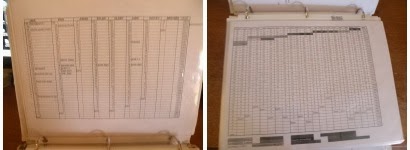
It helps to know the ages of each of the main characters, their children, brothers and sisters, and babies born that are relevant, so I create an age chart for each book (below left).  The first year at the top (in the right column of the graph) is the year in which the book takes place, then drops by each year, until the oldest character is born.  There's enough room to put a few words for something such as "moved to Desperation" or "Graduated high school," anything that might be a major event in time that appears as backstory in the book.  If it's a book within a series, I have a chart with the main characters' ages in all the books.  If there are children, those ages are listed, too. (below right)
Age charts story and Series Main Characters
Then comes the plotting.  While I do the original plotting on a big white board, I like to have a portable copy I can take along or have at hand to look at as I write.  I also create a calendar that has the scene on the date it takes place (one page per month).  It helps me know how time is progressing throughout the story, and I don't have to hunt for how long it's been since something has happened...or will happen.
Small storyboard and Calendar of Scenes


Another handy tool is to have a calendar of a full year.  I found a great place online that has a printable calendar that goes back in time and goes forward a few years, too.  Another aid in plotting is a timeline, which comes in handy with the full year calendar when working through the story calendar.  The timeline includes time of day.  It helps when plotting forward to see if all makes sense, before using the monthly calendar.
Full year calendar and Timeline
I've always loved looking at house designs and house plans.  When many scenes will take place in a particular place, such as a house, I look for a plan that will suit my character.  Why?  Without a "map," I get lost and forget if the kitchen is to the left or the right, or even where the staircase is located.  It's like playing with a dollhouse on paper. ☺  Because the setting of the series is based on the layout of the area around the town where I spent my junior high and high school years, I pulled up Google Maps and have several aerial shots.  Three of the books in the series involve two brothers and a sister.  A little mini-series within a series.  The house of the hero in DESIGNS ON THE COWBOY (June 2013) is modeled after my great-aunt and great-uncle's house, a Victorian built in the late 1800s.  I had to go by memory on the inside, but for the farm/ranch, itself, an aerial view helped with the outbuildings, roads, and more.  This house and surrounding area play a big part in my upcoming August book (the sister), and a neighbor's house, which really isn't there.  I added squares of paper to show where the house, barn, a large pond, and other things were located on the hero's property.
House plan and photo, with aerial shot of the layout of the land
Last but not least for the August book, I kept getting myself turned around in the area around the hero's ranch house, so I created my own little map, so I would know what the characters would see and how they would get to where they were going. (on left)  The photo on the right is my working calendar.  I began it about halfway through the series.  It helps me keep on deadline and get things done when they need to be done to beat that deadline. ☺
Layout of ranch yard and My Working Calendar
All of the above--and sometimes more--are kept in protective sleeves in the front of the binder, now a story bible.  Behind them are tabs for each printed chapter.  Again, for portability.  I often work while waiting to pick up grandkids from school.  Nearly everything for writing the story is in the bible.  Some have more information from research I've done, most don't have aerials or ranch "maps."  If I think I might need something, I'll add it.  Pockets in front and back of the binder are handy for extras, such as scribbled notes or ideas for later.

For more information on Story Bibles, check out Taming the Series Beast on my author blog.  There are also links there for information on how other writers create their bibles.

So there it is.  My method of keeping track.  While I'd never dreamed of writing a 10-book series, the first two books grew into more new books, and I'm thankful I'd already begun to keep a bible for each book.  To keep all the major series information and a complete list of all characters (even those mentioned) and a complete age chart, who they are and what books they appear in, I use a 1/2" binder.

Remember, if you decide to create a story bible, do it your way.  Mine is only one of many.

Are you completely confused?  Overwhelmed?  That's okay.  It's done little by little.  For more details, you can give me a shout in the comments.  There are always little tricks to make it easier.

Oh, and HAPPY THANKSGIVING!!!  (We're having our turkey day tomorrow.)

Writing a Series? These Links Might Help (Penny Rader)

http://amzn.to/18FkXUf
Totally forgot today was May 31st!  On the 31st of the months I try to share links to articles I've found that might be helpful to someone out there besides just me. And since I'm trying to plan and write a series, I trolled the internet for a bit of help.

Here are a few snippets of what I found. I hope you'll see something that'll make you want to click through and read the articles I found and perhaps find something helpful for your writing process.

The Continuity Challenge (Debby Giusti)

Steeple Hill Assistant Editor Emily Rodmell was in charge of the project, and I applaud her patience in keeping us on track and ensuring each book fit into the overall vision for the series. Shortly after she invited us to take part in the continuity, Emily sent out the “bible,” a 31-page, single-spaced outline for the series. Packed with information, it included an overview of the stories as well as the major threads, settings and brief character descriptions. The continuity elements and teasers needed in each book were part of the bible, as well.

Creating a “Series Bible” (Dame Jenna)

My preference is to work on my Series Bible when I’m in the proof-reading stage of a manuscript’s life cycle.  …  On a table right beside me are a handful of worksheets that are what I need to later create my “formal” Series Bible. The worksheets I have are: Recurring Places, Major Characters, Minor Characters (these being the “mentioned once and never heard from again” set, and Recurring Characters (these being secondary/minor characters who I know for sure are going to appear again). … As I read through the proofs, I jot down notes on my worksheets.

Easy Tips For Creating a Book or Series Bible (Angelique Armae)

…steps to creating a “Book Bible’ – a binder for keeping track of important threads that weave your work into a marvelous book

1. Gather supplies
2. Included contents

  • Characters
  • World
  • Clothing/Accessories
  • Research
  • Glossary

How to Write the First Book of a Series (H.V. Long)

H.V. discusses:
• Planned versus Unplanned Series
• Questions to Answer for Any Series
• Series Bible
• Types of Series

 Kate Douglas on Ending a Series

On ending a series:  It doesn’t kill the characters, but it can be hell on authors.

The Series Bible (Nathan Bransford)

The Series Bible is a lifesaver when your brain has reached capacity.
• Characters
• Worlds/Planets/Lands/Classrooms, etc.
• Rules of Law
• Any backstory that happens off the page
• Inventions/Special Powers
• Anything else you need to remember forever

Series Business – Three Types of Series (Misty Evans)

• Serials
• Sequels
• Spin-offs

Tips for Building a Series (Mima)

 In this post, I’m going to give you some tips, but these are tips directed at creating a very particular kind of series: a dynamic one. This is my mantra: Thou Shalt Not Be Repetitive. Here’s my recipe: It’s two parts common sense, one part restraint, and one part layering.

Why the Word "SERIES" Should Be on Every Writer's Tongue... And How to Get There With Minimal Blood Loss! (Tina Radcliffe)

1. Find a series-oriented author you love
2. Copy them (not blatantly)
3. Don’t box yourself in

~~~

Have any tips you care to share?  What works or doesn't work for you?

P.S.  I apologize for the odd formatting.  Blogger seems to have it in for me.

My Biggest Aid In Writing . . . Hmm, Aspirin?

When I heard the blog topic for this month I went, huh? I'm expected to limit myself to one book? Ain't gonna happen. Just like the other WARA ladies, I am an avid reader. Growing up I spent so much time with my nose in a book, family members stopped asking where I was at family events. It was easier to leave me to my story than to try and pry it out of my hands. They were probably afraid I would hurt them. They were probably right.

Reading was my safe place. I could enter any world, any situation, any adventure and come out in one piece. I could experience places that I may never see in the flesh. Reading opened up new thought processes, new realms, new cultures and new places for my vivid imagination to roam. I could be anyone I chose when reading. Do anything I wanted to do. (And not get arrested.)

Andre Norton was a particular favorite. Her Sci-Fi books were read and re-read for at least two decades. I still hunt one up every now and then. Phyllis A. Whitney was another. I was introduced to her at about age fifteen.  We were visiting relatives out of town and I had some serious female cramps going on. My aunt, bless her heart, gave me a paperback copy of Thunder Heights to read while prostrate on the couch. I was hooked. Now I had a serious avenue to walk my imagination down, love stories. I could write a new one every day . . . in my head. I'm sure being a hormone laden teen helped. The old Gothic Romances are still some of my favorites.

Barbara Mertz, aka Barbara Michaels, aka Elizabeth Peters, kept me busy for quite some time. I never get tired of reading Crocodile On The Sandbank or Summer Of The Dragon. I never drooled over Radcliff Emerson but Tom De Karsky, oh, yeah, big time! My mouth is starting to water even now.

. . . Uh hum, now back to the original subject. For me the biggest aid in writing was not a particular book but the computer. I willingly admit, if I had to hand write thousands and thousands of words to create my books, I would have never started. My hand cramps just thinking about it. My brain too. I applaud, with sincere praise for their dedication, all the writers over the centuries that wrote their stories with pen and paper. I guess I'm too lazy, or too horrified, of the thought of editing and re-writes. It boggles the mind.

I am still computer illiterate in many ways, just ask Roxann, but I can word process with the pros. Well, maybe not the pros, but at least my grand-kids! Okay, I try! Very hard!

I digress. Computers have made the writing process a thousand times easier and faster than writing by hand. Making an, oops, go away is simple. I have lots of those, and with the punch of a button, viola!, they disappear. I wish dust bunnies and dirty laundry would mind so well.

Even though I am not overly fond of technology, for the writer a computer is their best friend. You can type up any piece of junk you want and your computer will never tell, unless you forget to hit delete. You can also take that piece of junk and turn it into a masterpiece by working with it until it gels. Inserting, spacing, cut and paste, delete and new paragraphs can be used at will. Creation is work. Creation is often hard, but with the invention of the computer, it's easier than it's ever been since the beginning of time.

So, get to work!