Showing posts with label Learning Experience. Show all posts

What the &%^$$ is a Story Bible?

Small shelf of current WIP bibles
CONFESSION TIME

I'm a plotter.  I didn't start out that way, but as I continued to write, my critique partners/writing buddies told me I must learn to plot.  Yeah.  Sure.  Right.  Me plot?

But their reasoning was that once I sold a book or two, I'd need to be able to write a full synopsis.  I thought that if I knew what would happen in the story, it would totally ruin the fun of writing.  Those CPs were ruthless, and so I learned to plot.  Now I can't write without plotting. ☺

I'm visual.  I wish I would have known that in high school.  It might have saved a lot of hours...days...weeks.  But now that I know it, not to mention that the memory of something I thought of two minutes ago can vanish into thin air, I've become aware that if I don't write it down and keep it somewhere, a thought, an idea, a name, a conversation/dialogue between characters can be gone in a the blink of an eye.

I didn't start out building a bible.  I didn't even know there was such a thing.  Now I know that a lot of writers make them and use them.  Do a search on the internet for *how to build a story bible* and see how many articles are available.

The key to a bible is how you put it together.  Sue's won't look like Jane's.  Ann's won't look like Sue's.  It's an individual "thang" when building a bible.  You make and use what you need.  Pick and choose what works best for you.

My method is to use a 3" binder.  I started using white, but I've found that using a different color for different genres works well, too.  If I'd known I'd be writing a 10-book series, I might have chosen a special color for it.  I didn't, so all 11 binders are white.  (One for each book and a separate for the series.)

Outside front of bible
Like Penny and Melissa, I use pictures to start.  One of the hero, one of the heroine, and one each of a child or pet or whatever is needed.  I use my B&W printer to print them--no need for color.  Those are in a file on my computer. I slip the photo of the main characters into the front of the binder.  In the photo on the right, you can't see the photos, but there's a method to my madness.  Because I only plot the main idea of each scene, I don't know exactly what is going to happen, so as I'm writing and realize I need to change something in previous scenes that are written, I use sticky notes and put them on the front of the binder.  I also keep track (upper right of photo) of how many words and pages I've written, both by scene and chapter, and by date.

Heroine & Hero
Inside the binder, I use sheet protectors on the things I use the most.  The order in which I place them isn't always the same, but the basics are...until I realize I need to add something new.

Characters are the most important thing in a story, both who they are and what they look like.  (Harlequin likes us to send pictures of well-known people for our cover ideas.)  There are many places to find pictures for characters.  Modeling websites, photo sites (do a web search), even Pinterest are helpful.


Character List

Next comes a complete list of character names, starting with the hero and heroine and including the names of any characters that appear in the book or are mentioned by name.  After having to hunt for the name of the waitress at the local cafe, who appears randomly throughout the series, or the parents who were mentioned by name, but never appeared, I decided everyone with a name was needed, after all.  If a new character appears, the name and who they are (related to hero/heroine or minor character, even if only mentioned), that character goes on the list.


It helps to know the ages of each of the main characters, their children, brothers and sisters, and babies born that are relevant, so I create an age chart for each book (below left).  The first year at the top (in the right column of the graph) is the year in which the book takes place, then drops by each year, until the oldest character is born.  There's enough room to put a few words for something such as "moved to Desperation" or "Graduated high school," anything that might be a major event in time that appears as backstory in the book.  If it's a book within a series, I have a chart with the main characters' ages in all the books.  If there are children, those ages are listed, too. (below right)
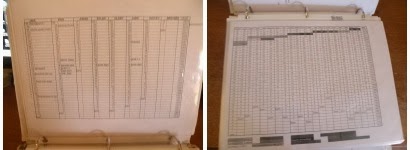
Age charts story and Series Main Characters
Then comes the plotting.  While I do the original plotting on a big white board, I like to have a portable copy I can take along or have at hand to look at as I write.  I also create a calendar that has the scene on the date it takes place (one page per month).  It helps me know how time is progressing throughout the story, and I don't have to hunt for how long it's been since something has happened...or will happen.
Small storyboard and Calendar of Scenes


Another handy tool is to have a calendar of a full year.  I found a great place online that has a printable calendar that goes back in time and goes forward a few years, too.  Another aid in plotting is a timeline, which comes in handy with the full year calendar when working through the story calendar.  The timeline includes time of day.  It helps when plotting forward to see if all makes sense, before using the monthly calendar.
Full year calendar and Timeline
I've always loved looking at house designs and house plans.  When many scenes will take place in a particular place, such as a house, I look for a plan that will suit my character.  Why?  Without a "map," I get lost and forget if the kitchen is to the left or the right, or even where the staircase is located.  It's like playing with a dollhouse on paper. ☺  Because the setting of the series is based on the layout of the area around the town where I spent my junior high and high school years, I pulled up Google Maps and have several aerial shots.  Three of the books in the series involve two brothers and a sister.  A little mini-series within a series.  The house of the hero in DESIGNS ON THE COWBOY (June 2013) is modeled after my great-aunt and great-uncle's house, a Victorian built in the late 1800s.  I had to go by memory on the inside, but for the farm/ranch, itself, an aerial view helped with the outbuildings, roads, and more.  This house and surrounding area play a big part in my upcoming August book (the sister), and a neighbor's house, which really isn't there.  I added squares of paper to show where the house, barn, a large pond, and other things were located on the hero's property.
House plan and photo, with aerial shot of the layout of the land
Last but not least for the August book, I kept getting myself turned around in the area around the hero's ranch house, so I created my own little map, so I would know what the characters would see and how they would get to where they were going. (on left)  The photo on the right is my working calendar.  I began it about halfway through the series.  It helps me keep on deadline and get things done when they need to be done to beat that deadline. ☺
Layout of ranch yard and My Working Calendar
All of the above--and sometimes more--are kept in protective sleeves in the front of the binder, now a story bible.  Behind them are tabs for each printed chapter.  Again, for portability.  I often work while waiting to pick up grandkids from school.  Nearly everything for writing the story is in the bible.  Some have more information from research I've done, most don't have aerials or ranch "maps."  If I think I might need something, I'll add it.  Pockets in front and back of the binder are handy for extras, such as scribbled notes or ideas for later.

For more information on Story Bibles, check out Taming the Series Beast on my author blog.  There are also links there for information on how other writers create their bibles.

So there it is.  My method of keeping track.  While I'd never dreamed of writing a 10-book series, the first two books grew into more new books, and I'm thankful I'd already begun to keep a bible for each book.  To keep all the major series information and a complete list of all characters (even those mentioned) and a complete age chart, who they are and what books they appear in, I use a 1/2" binder.

Remember, if you decide to create a story bible, do it your way.  Mine is only one of many.

Are you completely confused?  Overwhelmed?  That's okay.  It's done little by little.  For more details, you can give me a shout in the comments.  There are always little tricks to make it easier.

Oh, and HAPPY THANKSGIVING!!!  (We're having our turkey day tomorrow.)

Dream Vacation with a Grade--Steep by J Vincent


As a former teacher summer always meant a big change in routine.  There was usually a class to take to keep up my certification but it was vacation time.  A time for swimming lessons, three different set of ball game schedules and sometimes four if my husband decided to play too.  Large and small family trips were also part of these months.  They ranged from camping relatively close to home to going to Colorado and camping in the mountains.  One year my husband borrowed a popup camper and we went on an adventure from here to the Grand Canyon and back with many stops in-between.  One of the most memorable was going down Wolf Creek Pass to Durango, CO which has 7-10% grades.  I’ll never know what it is like going UP Wolf Creek Pass because going down it once was more than enough for me.  There’s only so much burning brakes I want to endure.  We stayed at a KOA camp that night and as I did laundry at midnight all the women there were talking about was coming down Wolf Creek Pass!

A few years later we took our own popup on a trip to Yellowstone National Park.  We went via Nebraska and the Dakota Badlands.  After we left the badlands and were a day out from the park we had to cross a mountain range--not sure of the name.  On the descent I was sitting with my feet up on the back small bench seat of our extended cab pickup.  I became concerned about the growing burned brake odor and swung my feet down as I sat up.  When my shoes hit the carpet they squished down and forward.  The carpet was actually melting!  By some miracle we were near the only house on this road and they had a garden hose which we used to cool the carpet down.  The good Lord must have felt sorry for us because by another miracle we got the last camp spot in Yellowstone the next day. 

The Grand Canyon and Yellowstone are truly memorable places.  I’m so glad we got to see them and the joys and travails getting there and back filled my writer’s “experience bucket” to the brim.  This summer we are looking forward to August and a week’s camping in our usual spot (I think it’s safe to call it that after forty some years of going there) at Thirty Mile Camp outside of Creede, CO.  Going there is sometimes adventuresome too.  We’ve blown tires, had engine trouble, and had kids get sick.  I’m hoping for a very sedate trip out and back this time.

Vacations can be memorable for many reasons.  We seem to hit extreme highs and lows on many of ours.  What about you?  What vacation story do you have to tell?  Do share it.

My Favorite Things (cue Julie Andrews)

My grandkids look at me as if I've lost my mind when I tell them to take care of their books, because books are their friends.  For me, growing up as an only child, books were my friends, especially when all the other kids were busy with something else.  Books opened up the world around me, whether fiction or non-fiction or even encyclopedias.  Is it a wonder I started wearing glasses in second grade, after reading books by nightlight?

It was no accident in later years that when I had an answer or a problem that I would go out and search for self-help books.  From being a better person and uncluttering my house to pregnancy and child-raising and everything in between, I had a book on it.  So when I came to the point of deciding that I wanted to be a writer, it was books that I turned to.

I still have one bookshelf filled with writing how-to books that contains one book that actually put me on the road: You Can Write a Romance...and Get It Published! by Yvonne MacManus.  That's where I found information on Romance Writers of America and the date of an upcoming National Conference.  I joined immediately, rented a car, and purchased plane tickets...all in one day.  That day changed my life.

Although You Can Write a Romance... was the book that put me on the path to--well, not stardom, by any means, but learning and happiness and new friends and more--it was only the beginning.  I discovered Debra Dixon's Goal, Motivation & Conflict, boosting my writing skill to a new level.  I met and became friends with author Elizabeth Sinclair, who penned The Dreaded Synopsis (A Writing and Plotting Guide), and have nearly worn off the cover.  I've not only used it for writing a synopsis, but for plotting, too.  The one book that is always within arm's reach is The Synonym Finder by J.I. Rodale.  It's basically a thesaurus, but contains only synonyms, and is nearly three inches thick.  I'm on my third copy.  The first two copies were only well-worn, but worn out.

But the best thing about all of this is not the books, but the people I've met along the journey.  There are my WARA friends and the Ditzy Chix, a group of 10-12 authors that came together in the summer of 2001 to share the ups and downs of being writers.  My friend Kathie DeNosky has always been my guide and inspiration, keeping me from throwing in the towel, many times.  In fact, we became best of friends at that first RWA conference in 1996 in Dallas, Texas.  We still laugh about the day the lightbulb lit over our heads when we realized at the same time what the difference was between Harlequin Temptation and Silhouette (now Harlequin) Desire.  The other who makes up our triad of craziness is Kristi Gold, who makes me laugh and makes me think.  Listening to one of our three-way phone calls as we brainstorm would leave most people dazed and confused.  But even with the three of us talking at once, we understand and help each other, whether it's brainstorming or sharing the trials and joys of life.

So that's it.  Books, books, and friends, none of which I could live without and am eternally grateful to each and every one.  Without them, I'd be sitting in a corner, gibbering senseless stories to myself.  Now I get to share that gibbering with many, many more.  What could be better?

Please Choose One


What is the most difficult or challenging part
of the writing process for you?


You're kidding, right?  The most difficult or challenging?   This is a multiple answer type question, isn't it?  There has to be a "Please choose all that apply" option.  Because, well, 
let's get real.  There isn't just one answer to that question, because it depends on when it's asked.

I have a long list of what's been difficult and challenging in this on-going journey of writing and publishing.  At this moment in time, it's this moment in time.  Yes, I'm serious.  The lack of time for everything--especially writing--is a major thing for me right now.   Some days it's having so little sleep that by 9 p.m., my brain has shut down and putting words on paper is an effort in futility.  But that's now.  What about then?

A year ago what was difficult and challenging was getting a book proposal accepted (aka being offered a contract).  I had 3 two-book proposals turned down aka rejected.  Seven years ago it was wondering if I'd ever see another published book when, after five years of being a part of Silhouette Romance, the line closed.  Twelve years ago it was struggling with the revisions on my second book, while going through a divorce.  The year before that I was ready to put writing aside and pretend I was a normal person who didn't hear voices in my head.  (I'm glad I didn't, if only for the fact that it kept me sane during a very difficult time in my life.)

The writing process can be likened to the parenting process.  Once we think we've solved a problem or our child has mastered something, we discover there's more teaching (and learning!) that needs to be done.  Baby won't sleep at night?  Potty-training not going well?  Problems in school?  Boyfriend/girlfriend just dumped daughter/son?  And a lot of times we just wing it.  We don't always have time to get help.  We just do it.

Writing is an ongoing adventure in learning with steps we each take, although not at the same pace.   Some people talk of writing, others write.  Those who choose to do it discover there are pros and cons, just as there are with everything.  But if we stick with it and work our way through--learn knew things and grow some thick skin--we conquer the difficulties and win the challenges.


I have a long list of things that repeatedly are difficult or challenging:
  • I love to plot, but it can be terribly painful.  
  • Sometimes I don't know if something works or not.  
  • I don't feel like writing.  The words just won't come.
  • I can't think of a idea for a book.
  • My character is being stubbornly willful and I can't control him/her.
  • At various points in the writing of a story, I become bored with it.
  • Before I finish one book, the characters of a new book start talking in my head.
  • I fear rejection, not because it hurts, but because writing helps pay the bills.
  • I fear acceptance, because it means I have to (a) get to work, (b) pray I can do it again, (c) meet a whole new set of deadlines.
  • Setting goals is fun and easy, but meeting them is a battle, and sometimes I don't succeed.
  •  There is never, ever, ever enough time to do it all.  As my Twitter bio says, 'Sleep is highly under-rated.'  I need sleep to be able to function, and it's always in short supply.
Is any of that familiar to anyone?

How do I overcome those difficulties and challenges?  

Conference Oopsies

DATE: July 2007
LOCATION: RWA National Conference, Dallas, TX

Get 2000 people, mostly women, mostly romance writers, agents, and editors, together, and the setting is ripe for social gaffs.  Sure, we're all trying to be on our best behavior and hope to make good impressions on the people we meet, but we're also human.  We're fallible.  We make mistakes.

For those walking the road that may lead to that first book sale, a conference provides a place to meet and possibly talk with an editor or agent who might be interested in seeing their work.  A brief introduction with these professionals can sometimes gain a writer an invitation to submit.

For published authors, it's a chance to meet with their editor, agent, and fellow authors.  It's about participating in the book signing that raises money to fight illiteracy and is a great chance to meet readers.

For everyone, it's about networking.

For someone like me, it's an open invitation to embarrassment.

The 2007 RWA conference is the perfect example of the ineptitude that sneaks up on me at the worst times.  One of my closest and best writing friends lost her husband earlier that year, so she and I roomed together at the hotel.  The first night, we talked into the wee hours of the morning.  Wee=about 6 a.m. when we both finally fell asleep.  I had a 9 a.m. Meet & Greet to attend.  I managed to make it there on time, but I was a zombie.  When a woman walked up to me with her hand outstretched and introduced herself (first name), I shook her hand and gave her my name.  I didn't say anything else, because my brain hadn't yet kicked in.  She looked at me as if I was on drugs, then turned to walk away.  She'd taken three steps when I realized she was my new senior editor.  Now, how I was I going to undo that faux pas?  I didn't even try and felt like a fool for the rest of the hour.  It was definitely not one of my finest moments.

The luncheon with the same senior editor was a few days later, and I can't say it went much better.  The waitress didn't seem to understand that all I wanted was a salad, and it took some explaining, while all the other authors at the table looked on as if...  Yeah, you get the picture.

Friends have told me it was nothing to worry about, and although I've taken their comfort to heart, I still feel that tiny squeeze of embarrassment when I think about how foolish I was.  Does my senior editor remember?  I don't have a clue.  I haven't been back to a conference since then, nor had the opportunity to speak with her.  At best, if I'm lucky, she's probably forgotten.  At worst...well, it hasn't kept her from giving the "buy" nod to my books, so maybe it wasn't the grand oops that I remember.

Lesson learned?  In the future, I will make sure I've had enough sleep to form coherent thoughts and words. But to tell the truth, I've been known to become tongue-tied at the worst possible times, so even sleep may not put an end to embarrassing moments.  I guess that's just part of life, and it's best to forget these incidents, if possible, or to at least learn to laugh at them.  After all, we all make mistakes.

Mistake or Learning Experience?


There are two kinds of writers.  Plotters and Pantsers.  Plotters tend to outline their stories and follow the outline faithfully.  Pantsers on the other hand, write by the seat of their pants or in a much more freewheeling spontaneous style.  I slowly evolved from a dyed-in-the-wool plotter to a hybrid with characteristics of both styles.  That I needed to be more of a pantser (read that my characters needed me to be) was brought home like a proverbial 2x4 up side the head during the writing of the fourth book in my Honour series.  Honour’s Redemption took an eternity to write.  Well, not an eternity but it seemed that long since I ended up writing the first half twice.  How did that happen?  Was it a mistake?

I had always outlined my stories and was accustomed to my characters occasionally going their own way.  It usually wasn’t a big detour and the story followed the outline more rather than less.  Forgive a small aside here: I’ve never been able to understand or explain how the characters I create act like my children in that they do their own thing no matter how I feel about it.  I worried for my sanity until other writers mentioned having similar problems.  The end result is the same--if I don’t let my characters have their way the story will stall out and go nowhere.  When it came to Honour’s Redemption the characters evidently decided I need a writing life lesson.

After outlining Redemption I started writing.  Somewhere around Chapter Four my hero and a couple of my minor characters started objecting to the direction of the story.  I put my foot down or rather my finders to the keyboard, and wrote on ignoring their protests.  By Chapter Seven I was getting uneasy about the tone of the story.  It was dark to a degree anyway but it was taking on a more sinister rather than redemptive quality.  I still refused to listen to what my characters were whispering in my head.  This was MY story I was going to write it \MY way.  The outline or the highway.

Then in Chapter Eleven a minor character was raped.  This scene was not in my outline.  “How could this happen?” I asked in stunned horror.  I, after all, was writing the story.  The incident had nothing to do with my image of my main characters’ journeys-- physical, emotional or otherwise and I did not want this incident in my story.  And the story was dead on the monitor or perhaps more realistically completely, totally stalled in my mind.  I tried rewriting the chapter to take it another direction.  That went nowhere.  I put it aside for a week and when I came back to it I struggled until I admitted that I didn’t have a glimmer of an idea about how to fix it.  I put it aside again.

Two months later, and over 200 pages into the book, I came to the conclusion that the only way the book would get written was to throw out what I had and start over.  I bit the bullet, reread the outline, and began again.  But this time I let the characters lead the story.  I steeled my nerves and re-outlined when they got too far off the Roman numeral track.  At the mid-point of the story I heaved a huge sigh of relief.  While the tale wasn’t following MY outline it did have the tone I wanted.  Evidently the characters also decided I had learned my lesson.  I wrote the last third of that book, 130 plus pages, in less than a week.  I usually write faster when I near the end of writing a book, just like I read faster when reading a book.  I can’t wait to find out how it ends in either case.  I mean, we all know boy gets girl or vice versa but HOW?  That is what I must know.  This time the words, the scenes just flowed from my fingers like magic.  Gives me a chill just to recall it.

I still plot but I learned from my experience with Honour’s Redemption and never stand in the way of my characters for long.  Are your characters as independent as mine?  Or am I a few keys short of a keyboard?

Some ME Time

If you could spend a week anywhere in the world, where would it be? Would you write or read there, or do something else?
 That is a tough question for me.  As a small town, Kansas born and bred kind of gal, I haven't traveled much at all.  There is a huge world out there beckoning with so many places to go and things to see and do.

I have to admit I've never really wanted to travel the world.  Getting a passport and going through all the stress of that sort of traveling has it's rewards to be sure.  Scotland, Ireland, Australia... I could go on and on.  All of those places would be amazing to see.  Those far away places do tempt me, but I rather like the idea of keeping my feet in the USA and seeing all the amazing and beautiful places this country has to offer.

 The first place that pops into my mind when I think about getting away to somewhere is Chicago.  I have friends there that I've never actually met and I'd love to spend some time with them as well as see some of that part of the country.  I'm pretty sure there would be no reading or writing going on.  There would be research though.  Seeing new things and getting ideas for future stories would be on the agenda.


Another place that would come very close to beating out my hope of seeing Chicago, is my dream to some day stay in a private and very secluded beach house.  Relaxation and 'me' time would be the only goal there.  Relaxing on a deck that overlooked a great view of a sandy beach.  Waves lapping against perfect, smooth sand... a gentle breeze.  Me, a notepad, a tall glass of something cool to drink and a comfy place to just relax and enjoy the view.

If I could go anywhere in the world my own private beach house would be it.  You're all invited but you have to bring something along that will make our stay even more fun.  Anyone wanna join me?