Showing posts with label Organizing Tips and Tricks. Show all posts

There's Always Hope

Photo credit
No, that is not my desk.  I took the hutch off my desk, and it now resides in the storage shed in my backyard.  Along with an older hutch.  Yikes!  And, at the moment, the main part of my desk does not look like that.  Yes, there are a few things scattered on it, but only one notebook, a folder, and my Kindle are in a pile.  You see, I cleared off my desk a couple of weeks ago.

The rest of my office?  Don't ask.  But I want you all to know that last night, I did some sorting and tossing.  I cleared a corner of items that had been sorted to be put away or dumped, but had become a total mess.  It's now manageable and ready for some larger tossing.  I've decided to enlist the grandkids' help with shredding papers, and I gathered a stack of folders for papers to be filed. I even did some filing!

There will always be piles.  Like Becky, I usually have a good idea in which pile whatever I'm looking for can be found.  Generally.  But that doesn't mean we're disorganized.  What we are is busy, active people.

Raising four daughters was chaotic.  Raising anything is chaotic.  Yet we survived.  Nearly fifteen years ago, I divorced and left my home, taking the girls with me.  In the next two years, we moved three more times.  Each time, we tossed things into boxes and moved, never having time to sort through much of anything.  We're still sorting and tossing, after living here for the past eleven-plus years.  In fact, #3 daughter is coming later today to retrieve and toss her things from my attic.  Anything left is either mine to keep or dispose of.  Let's hope most is disposal.

But what you see is not always who you are.  I quipped yesterday to a friend in an email that I'm OCD and disorganized.  My youngest says that's not possible.  Oh, but it is!  There are certain things that must be done JUST SO, and to blazes with others.  All anyone has to do is take a look at my stringent writing schedule when on deadline, glimpse my story bible or my word count/page count charts, and you'll see the perfect example of Obsessive Compulsive Disorder.  Why?  Because I have to.

And my comments about being a disorganized organized person?  (I think I finally have that right!)  Unbelievably true!  And I have proof!  While searching for a photo for today's post, I found not only the above photo, but an article that shed light on the subject.  Are You Disorganized or "Differently Organized"? pretty much nailed me.  Check it out.  Read the first paragraph and see if you don't agree.  I've been in one of those homes mentioned in the first paragraph.  In fact, only one room--an enormous and  beautifully maintained family room--was used very much.  In fact, I think the couple lived mostly in there.  Why would I think that?  The carpet in the (formal) living room had plastic runners on the carpet.  I'm not kidding!

There's always hope.  There's always room for improvement, even if it's something as simple as a pencil holder for our desks.  Instead of beating ourselves up, let's celebrate who we are and make improvements when we feel they're in our best interests.  Set priorities.  Are plastic runners on your carpet high on your list?  Go for it!  Do you feel comfortable with easy-to-find-piles or containers?  Enjoy!  Whatever makes your life easier, yet still comfortable and with a little room to improve, is basically all we need.  Live life!  Be happy!

Armed with a labeler and I’m not afraid to use it (Melissa Robbins)

   Organization is key with writing.  How would you keep it all straight?  Plot, characters, research.  It’s a good thing I like office supply stores more than one person should, but here are just some of the examples I found useful in my writing endeavors.

Notebooks – Go find the prettiest notebooks you can find or buy up a bunch during back to school sales in the summer.  Here is my collection of notebooks.  I’ve labeled each one with my handy dandy labeler.  Character information fills some.  Other notebooks contain research material, which brings me to number two.

Notebook Tabs – The same tab organizers I used in school for my different subjects help keep my information straight.  My teachers would be so proud.  These tab dividers separate RAF research, like planes,  aerodromes and 40’s fashions, etc. 


  Leather Notebooks – I once saw on an author’s blog how she used handcrafted leather notebooks to keep notes, story ideas, pictures, etc. straight.  Who wouldn’t be inspired by a beautiful notebook?  I made the two books on the left myself using supplies from Hobby Lobby.  The paper is thick sketch paper great for pens and markers.  I fill mine with scene and story ideas, sketches of my characters, locations, character information. They are easier to transport than my larger notebooks.  If you don’t want to make a notebook, Barnes and Noble has some beautiful ones.

Spreadsheets – Where would I be without my Excel spreadsheets?  Probably still combing through pages of my stories searching for George’s eye color.  With so many pilots and other characters running through my aerodromes and cities, spreadsheets allow me to keep track of all of them in one place.  Spreadsheets also aid me in corralling all the agendas.  In a mystery, everyone has secrets, but which character is willing to kill to keep that secret quiet?  My heroine may not know what’s going on behind the scenes, but I need to know. 


That’s just some of the tools I use to organize my writing.  What works for you?

Herding Cats, er, Herding Ideas: Organizing Tips for Writers (Penny Rader)

Bing image
My oldest daughter hosted our family for Easter lunch this past Sunday.  While we were eating, my mom asked if I’d been writing.  I smacked my forehead and said I had a blog post due, asked what the date was (my brain is still slightly addled from tax season), and was quite relieved when I realized I still had two days to pull together a post.

Daughter #2: “What is the topic?”  

Me: “Organization.”

She laughed out loud, which reminded me of a time when she was a little girl.  One day, while I braided her hair, she sat directly across from my bookshelf.  “Mom, you have a lot of books about getting organized.”

“Mmm, hmm,” I agreed.

“I guess you haven’t had a chance to read them.”

I fear my hands might’ve slipped and may have given a slightly sharp tug to the braid I was working on.

So, since anyone who knows me knows I’m a disorganized mess, I figured we’d benefit more if I checked around and found some tips and tools that worked for others and might work for us.  (Just for the record, I do like to be organized.  I just struggle with maintaining the organization…which then results in having to start again and again, usually after I have huge piles of stuff here and there and can’t find anything I’m looking for.)

Here are a few tidbits I discovered on my online search.  I do hope you’ll click on the links to gain the full benefits of the following authors’ wisdom.

  1. Carry paper with you.
  2. Construct, then write.
  3. Consider going digital.
  4. Don’t plan at all.

  1. Create a mind-map.
  2. Build your world.
  3. Develop the setting.
  4. Make character sketches.
  5. Visualize the end product.

10 Ways to Organize Your Book (Cassandra Marshall)
  1. Dry erase boards or Acrylic sheets.
  2. Post it notes.
  3. Crayola bathtub markers.
  4. Mirrors.
  5. Small voice recorders. Voicemail.
  6. Small pad of paper and pencil.
  7. Scrivener or Evernote.
  8. Clear packing tape on cardboard or your window.
  9. Desk mats
  10. Chalkboard paint.


Bing image
Low-tech organizing tools: 
  1. Sketches.
  2. Lists and outlines.
  3. Index cards.
  4. Sticky notes.
  5. Hanging folders
Software and Internet-based organizing tools:
  1. List and outlining tools
  2. Spreadsheets.
  3. Drawing programs.
  4. Mind maps.
  5. Storyboards.
  6. Transcription.
  7. Cloud computing.

How to Organize Your Desk to Aid the Needs of a Writer (by H.H., Ben Rubenstein, Dvortygirl, Flicket, and others)
  
Writing by Hand:
Bing image
  1. Take everything off your desk.
  2. Organize all papers into piles.
  3. Clear off the knick-knacks.
  4. Store your pens and pencils in a mug…
  5. Toss any pens or pencils that don’t work…
  6. Arrange paper, notebooks … within easy reach.
  7. Buy a drawer organizer…
  8. Replenish your supplies when necessary.
  9. Get a good light for the top of our desk.
Writing by computer
  1. Clear all junk on your desk
  2. Relocate anything that casts a shadow…
  3. Look on the desktop of the computer itself and remove all unnecessary icons…
In either case:
Bing image
  1. Get a nice chair.
  2. Locate the desk in a quiet location…
  3. Keep a notebook or legal pad at hand…
  4. Locate the desk lamp so that your hand does not cast a shadow on your writing.
  5. Keep reference materials nearby…
  6. Set up time to regularly address (toss, file or handle) the things that stack up on a desk…
  7. Consider carrying a portable desk…
  8. Finished.


When your ideas run wild, it’s too easy for them to frustrate and eventually overwhelm you. And this is where many writers give up. But you shouldn’t.
  • Learn how to tame your beast:
  • Establish a calm, centered mind
  • Study your breed.
  • Train your focus.
  • Walk your inner dog.


To find the method that works best for you, experiment with the following plot structure organizational tools:
Bing image
  • Index cards
  • Outline
  • Folders
  • Loose-leaf notebooks
  • 3-ring binders
  • Flow charts
  • Writing software
  • Your computer

-- some good ideas in the comments, also.
  • Organizing by scene:
  • Scene
  • Setting
  • Characters introduced
  • Characters mentioned
  • Backstory
  • Things to add
  • Things to delete
  1. A writer’s notebook
  2. Storyboard
  3. An inventory list
  4. Character timeline
  5. Printed drafts in a binder

  1. Identify your major scenes.
  2. Grouping scenes.
  3. Make a timeline.
  4. Make a hit-point list.
  5. What else must happen?
  6. Prioritize your scenes.
  7. Recheck your timeline.
  8. Start at the natural beginning.
  9. Where to from here?
  10. Organizing the train wreck.
~~~

What do you think?  Find anything helpful?  Have any tips to offer?

Organize to Succeed by J Vincent


The topic for this month is organization.  When it comes to writing there are several areas that need organization.

First is where you write.  Not only the environment but the computer you use.  Follow whatever arrangement seems most logical to you and that fits your situation. I have on my desk within easy reach a first name book, a surname book, a thesaurus, a dictionary and the relevant books I’m using for fact checking in my current book.  Many of these items can now be online resources. I have those I use frequently bookmarked in a folder named Resources on my browser.  Having them in a folder organizes them for fast and easy use instead looking through a ton of bookmarks. 

For my writing I organize my computer files in folders.  I have a main folder for a book in which I save the writing files and then subfolders for whatever areas that particular book needs. I still have a binder for each book I write despite the fact I also now keep the same information on my computer.  In both binder and computer I have a section/folder on characters where I paste a picture and also have a physical description as well as character traits and important events in the life of that character that predate where the book begins.  Since I write historicals I also have a calendar section for the months of the particular year(s) I am writing, like September through December of 1810 for my present book and a timeline of real and fictional events in the story.  Another section is for plot outlines and scene notes.  I also have a section for locations with photos or pictures clipped from wherever along with notes and diagrams of homes or castles or forts that my characters will have to move-fight through.  When I am writing and find I must make big changes I re-save my file with the present date.  That way I have the “old’ and “new’ versions.  I also save scenes I cut, especially if they are long.  You never know when you might want that information or scene again.  And since I sometimes self-publish I also have a folder for what I need to include in the ebook version.

Writing time also has to be marshalled to be available.  That may be exceedingly difficult in a busy life but I’ve learned if you don’t plan a time for it, you will never find any in which to actually write.  I don’t think it should be carved in stone but some workable framework has to be constructed to find available slots for writing in your day.  Once those are identified, set small incremental goals to use them.

All of this organizing will make writing easier.  You won’t waste time looking for information you know you have and will get more productive writing accomplished.  I’m sure I missed some areas and/or didn’t expand enough on others.  What organization techniques do you find most useful in your writing?

What the &%^$$ is a Story Bible?

Small shelf of current WIP bibles
CONFESSION TIME

I'm a plotter.  I didn't start out that way, but as I continued to write, my critique partners/writing buddies told me I must learn to plot.  Yeah.  Sure.  Right.  Me plot?

But their reasoning was that once I sold a book or two, I'd need to be able to write a full synopsis.  I thought that if I knew what would happen in the story, it would totally ruin the fun of writing.  Those CPs were ruthless, and so I learned to plot.  Now I can't write without plotting. ☺

I'm visual.  I wish I would have known that in high school.  It might have saved a lot of hours...days...weeks.  But now that I know it, not to mention that the memory of something I thought of two minutes ago can vanish into thin air, I've become aware that if I don't write it down and keep it somewhere, a thought, an idea, a name, a conversation/dialogue between characters can be gone in a the blink of an eye.

I didn't start out building a bible.  I didn't even know there was such a thing.  Now I know that a lot of writers make them and use them.  Do a search on the internet for *how to build a story bible* and see how many articles are available.

The key to a bible is how you put it together.  Sue's won't look like Jane's.  Ann's won't look like Sue's.  It's an individual "thang" when building a bible.  You make and use what you need.  Pick and choose what works best for you.

My method is to use a 3" binder.  I started using white, but I've found that using a different color for different genres works well, too.  If I'd known I'd be writing a 10-book series, I might have chosen a special color for it.  I didn't, so all 11 binders are white.  (One for each book and a separate for the series.)

Outside front of bible
Like Penny and Melissa, I use pictures to start.  One of the hero, one of the heroine, and one each of a child or pet or whatever is needed.  I use my B&W printer to print them--no need for color.  Those are in a file on my computer. I slip the photo of the main characters into the front of the binder.  In the photo on the right, you can't see the photos, but there's a method to my madness.  Because I only plot the main idea of each scene, I don't know exactly what is going to happen, so as I'm writing and realize I need to change something in previous scenes that are written, I use sticky notes and put them on the front of the binder.  I also keep track (upper right of photo) of how many words and pages I've written, both by scene and chapter, and by date.

Heroine & Hero
Inside the binder, I use sheet protectors on the things I use the most.  The order in which I place them isn't always the same, but the basics are...until I realize I need to add something new.

Characters are the most important thing in a story, both who they are and what they look like.  (Harlequin likes us to send pictures of well-known people for our cover ideas.)  There are many places to find pictures for characters.  Modeling websites, photo sites (do a web search), even Pinterest are helpful.


Character List

Next comes a complete list of character names, starting with the hero and heroine and including the names of any characters that appear in the book or are mentioned by name.  After having to hunt for the name of the waitress at the local cafe, who appears randomly throughout the series, or the parents who were mentioned by name, but never appeared, I decided everyone with a name was needed, after all.  If a new character appears, the name and who they are (related to hero/heroine or minor character, even if only mentioned), that character goes on the list.


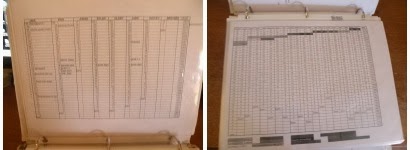
It helps to know the ages of each of the main characters, their children, brothers and sisters, and babies born that are relevant, so I create an age chart for each book (below left).  The first year at the top (in the right column of the graph) is the year in which the book takes place, then drops by each year, until the oldest character is born.  There's enough room to put a few words for something such as "moved to Desperation" or "Graduated high school," anything that might be a major event in time that appears as backstory in the book.  If it's a book within a series, I have a chart with the main characters' ages in all the books.  If there are children, those ages are listed, too. (below right)
Age charts story and Series Main Characters
Then comes the plotting.  While I do the original plotting on a big white board, I like to have a portable copy I can take along or have at hand to look at as I write.  I also create a calendar that has the scene on the date it takes place (one page per month).  It helps me know how time is progressing throughout the story, and I don't have to hunt for how long it's been since something has happened...or will happen.
Small storyboard and Calendar of Scenes


Another handy tool is to have a calendar of a full year.  I found a great place online that has a printable calendar that goes back in time and goes forward a few years, too.  Another aid in plotting is a timeline, which comes in handy with the full year calendar when working through the story calendar.  The timeline includes time of day.  It helps when plotting forward to see if all makes sense, before using the monthly calendar.
Full year calendar and Timeline
I've always loved looking at house designs and house plans.  When many scenes will take place in a particular place, such as a house, I look for a plan that will suit my character.  Why?  Without a "map," I get lost and forget if the kitchen is to the left or the right, or even where the staircase is located.  It's like playing with a dollhouse on paper. ☺  Because the setting of the series is based on the layout of the area around the town where I spent my junior high and high school years, I pulled up Google Maps and have several aerial shots.  Three of the books in the series involve two brothers and a sister.  A little mini-series within a series.  The house of the hero in DESIGNS ON THE COWBOY (June 2013) is modeled after my great-aunt and great-uncle's house, a Victorian built in the late 1800s.  I had to go by memory on the inside, but for the farm/ranch, itself, an aerial view helped with the outbuildings, roads, and more.  This house and surrounding area play a big part in my upcoming August book (the sister), and a neighbor's house, which really isn't there.  I added squares of paper to show where the house, barn, a large pond, and other things were located on the hero's property.
House plan and photo, with aerial shot of the layout of the land
Last but not least for the August book, I kept getting myself turned around in the area around the hero's ranch house, so I created my own little map, so I would know what the characters would see and how they would get to where they were going. (on left)  The photo on the right is my working calendar.  I began it about halfway through the series.  It helps me keep on deadline and get things done when they need to be done to beat that deadline. ☺
Layout of ranch yard and My Working Calendar
All of the above--and sometimes more--are kept in protective sleeves in the front of the binder, now a story bible.  Behind them are tabs for each printed chapter.  Again, for portability.  I often work while waiting to pick up grandkids from school.  Nearly everything for writing the story is in the bible.  Some have more information from research I've done, most don't have aerials or ranch "maps."  If I think I might need something, I'll add it.  Pockets in front and back of the binder are handy for extras, such as scribbled notes or ideas for later.

For more information on Story Bibles, check out Taming the Series Beast on my author blog.  There are also links there for information on how other writers create their bibles.

So there it is.  My method of keeping track.  While I'd never dreamed of writing a 10-book series, the first two books grew into more new books, and I'm thankful I'd already begun to keep a bible for each book.  To keep all the major series information and a complete list of all characters (even those mentioned) and a complete age chart, who they are and what books they appear in, I use a 1/2" binder.

Remember, if you decide to create a story bible, do it your way.  Mine is only one of many.

Are you completely confused?  Overwhelmed?  That's okay.  It's done little by little.  For more details, you can give me a shout in the comments.  There are always little tricks to make it easier.

Oh, and HAPPY THANKSGIVING!!!  (We're having our turkey day tomorrow.)

My Leather Novel Journals (Melissa Robbins)


       When Penny mentioned ways to store and keep track of all the materials and information, I thought, “Aha!”  I’ve wanted to show these to the WARA members, my leather novel journals.  Binders that keep track of all the material I amass on WW2 and my characters fill my shelves and are useful and practical, BUT not very pretty.  I wanted something I could use to combine notes, sketches, and photographs.  Something my characters could very well carry around themselves.  Yes, I could go out a buy a leather journal, but there was something about creating my own from scratch. 

               I got on YouTube and figured out how to bind books.  I now know what those bumps are on the spines of old leather books.  I picked up the real leather, embroidery floss, and drawing paper at the craft store (on sale).  The hardest part was making sure all the holes lined up correctly, but the process is relatively easy.  If you can sew with a needle and thread, you can bind a book.  

                The fun part was selecting all the embellishments that reflected my main characters.  Steampunk elements were perfect for one hero and I created the wings from various jewelry parts.  That book stays closed with a purse snap.  My second book reflects my hero and heroine.  The pocket watch compass and gold heart-shaped locket are items near and dear to their hearts. 

  Here is a page out of one of them.  I used the photo corners my grandmother used for her albums to hold a photograph of Veronica Lake who my heroine resembles.  I also included information about her, a sketch of her in her nursing outfit, and a list of all the parts of her service dress as well.  Summer and winter dress were different.  Don’t want to mix them up. 

               The book also contains copies of pilot logbooks and combat reports, pictures of pilots working and at leisure, scene ideas, and pretty much anything related to my stories.  

MIRROR MIRROR ON THE WALL

I have to admit and apologize that I've been AWOL for most of July. I had out of state company and spent the most wonderful month playing grandma to my three year old grandson. So, when I rolled the calendar over to August and saw the big red letters B L O G on the 4th, I emailed our resident blogging guru goddess, Roxann and asked what our topic was this month.

POV Point Of View!!!!

Seriously? I'm probably the worst one to give advice on this very important subject. I would never forgive myself for clouding the minds of aspiring writers with tainted information and misguided advice. Having decided this was a topic better left to the experts (you know who you are) I decided to approach this whole POV issue a different way and introduce you to a topic that is very near and dear to my heart. And other parts of my anatomy.

POVFTM Point Of View From The Mirror

That's right. Something new to consider. As writers we spend a good portion of our time in our comfortable Office Depot faux leather chairs. If we're lucky, our fascinating characters are behaving, the hamster wheels in our brains are turning, our fingers are flying over the keyboard in record speed and our backsides are spreading faster than wildfire.

Sad but true my dear friends and fellow writers. If given the choice we would spend all day in front of our computers drinking Coke and nibbling on chocolate long johns or eating chips and dip like there was no tomorrow. I know I would. We might be writing the great American novel, but our bodies are turning into the great American tragedy. We're not doing ourselves, or our mirrors, any favors.

I speak from experience.

Next time we get stuck and just can't think of what perils to thrust upon our characters, we need to get up and walk the dog. Do push ups against the wall. Attempt 25 jumping jacks. Walk around the house or to the park. Go downstairs and start another load in the washing machine. Dust off that treadmill and cruise for a mile or two. Exercise fuels the brain, strengthens the heart and gets the creative juices flowing.

Try this for a week or two. Set a timer and get up and move every thirty minutes. Your characters will still be there when you get back. Who says you can't plot while you're on the treadmill. Who cares what the neighbors think if you talk to yourself while walking down their street. Think of this as multitasking.

Remember, only you can change your Mirror's Point Of View.

Trust me on this.

Hugs,
Reese

Coming Soon: A New Year

With Christmas over, it means it's time to think about New Year's Resolutions. "I resolve to fill in the blank in 2010." But while we're all thinking of passing up anything with more than 200 calories, let's focus more on goals for the year, especially writing goals.

What are goals? Dictionary.com defines a goal as the result or achievement toward which effort is directed; aim; end. Synonyms are target; purpose, object, objective, intent, intention. Good words! Even better because they can help us make goals.

Reaching a goal takes effort.

One caution when creating a goal. Aim for goals that can be achieved. A goal needs to be within your control. For instance, a goal of selling a book isn't completely achievable. None of us can control what or when an editor or publisher will buy, but what we can do is write the book and submit it.

If you have a large goal for the year, break it down into smaller ones. Large goals, such as submitting a manuscript, should be a series of small, achievable goals.

1. Find the right publisher for your idea.

2. If research is needed, do as much as possible before starting to write. That doesn't mean that once you're into the writing you can't look up specific information you need, but knowing a little about your hero or heroine's career from the beginning can mean not having to go back and revise later.

3. For those who plot, do it now. For those who don't, and idea of the beginning, middle, and end of your book can be a big help and keep you focused.

4. Writing a book definitely requires writing pages. But what if writing 200 to 300+ pages seems like a daunting task? Break it down! It's been said countless times that if a writer writes only one page a day, at the end of a year there would be 365 pages written. That's equivalent to 91,250 words!

But maybe you aren't ready to submit a book to a publisher. What other goals might you be thinking about?

Coming up with a story idea? Ideas are everywhere! Watch the news, read a newspaper, even watching people in the mall can generate an idea. If you have an idea, but don't know how to work it into a book, try brainstorming with friends or a critique group or partner. 'What if' is great way to put a story together.

Entering a contest? Kick off 2010 with WARA's Right Hook contest in March, followed by our Flyover contest in June, and ending with our HEA (Happily Ever After) contest in November. Work on entering each of these contests throughout the year, and you may end up with a finished book by this time next year. If you're an RWA member, many chapters have contests each year. Those can range from the opening to the first chapter or even a specific type of scene.

Check the internet for more ideas on how to make and achieve your goals. You can start with tips from Renee Knowles' Do You Have a Plan. Good luck!

Charts, and Graphs, and Tracking! Oh My!

(I'm running late this morning because of staying up until the wee hours to work on blogs.)

If given the chance, I’d be happy to spend most of my time creating ways to keep track of the things I do rather than doing them. It took me years to realize that I’m a very visual person. It helps keep my thinking clear when I can see an overall view of things. It also helps me remember things if I see them in writing.

Not only do I make the charts and graphs, but I keep them current with information so I know where I am pre-writing, during writing, and after writing. Give me a task or schedule, and I’ll make a chart or table or graph to track it.

Computers have made tracking easier, quicker, and less likely to get lost in a pile of papers. You don’t have to spend a lot of money on bookkeeping or tracking or plotting software. Nearly everything you need is probably already on your computer. It’s like having GPS in your car or on your cell phone. You can easily and quickly find out where you are and how to get where you’re going.

There are three basic programs I use: Microsoft Word, Works, and Excel. You might be surprised by how I use them.

While While Writing
(I keep a copy of each for each manuscript I start.)

  • Calendar (Word Calendar) -- to keep my timelines straight.
  • Characters (Word table) -- so I don't have to go looking to see what the waitress's name is.
  • Daily pages written (Excel) -- especially helpful during BIAW ;)
  • Age Chart (Works Spreadsheet or Excel) -- to know when main characters were born, went to school, had a major event in life, and at the time the story opens.
  • Proposal Page Count (Word table) per 3 chapters: #pages, date completed, #words for rough draft, 1st round revisions, 2nd round revisions, requested revisions pre-sale.
  • Status (Word table) – from submission through sale date
  • Storyboard (Word table) – my plotting device
  • Timeline chart (Word using Drawing) – for series

After Sale

  • Page count table (Word table) per chapter--A longer version of the Proposal Page count from chapter 1 through 12 (my usual book length)
  • Page goals (Word table) – for each chapter: date to be written, date started, date finished, date revised (final revision before submitting) and a check-off box
  • Percentage written (Word table) – broken down in increments of 5%, with #pages, #words, total running word count, date reached, in what chapter reached.
  • Running totals (Word table) – more detailed version of the running word count.

Completed Books

  • Completed book checklist (Word table)
  • Working Calendar (Word Calendar) -- to keep me on track when finishing a book. Call it my Goals Calendar
  • AAs/Galleys (Word table)

General

  • Response time charts (Word table) -- for tracking length of time between submission through responses and payments
  • Book Title, Submitted As, Hero Name, Heroine Name, Sold Date, On Sale Date
  • Yearly Pages Written

And those are only the tracking sheets I use most often. There are a few more old ones that I rarely use, but I’ve kept them, just in case. The above are tweaked and changed when needed, and, yes, I keep the information in each current as I work. That’s how I know where I am and how much it’s going to take to get me to the end of each project, whether a proposal or the finished book.

After creating a few Word tables, you can set them up quickly. You'll need an overall idea of how many columns and rows you need. Excel can be used for more than numbers! And Works comes standard on most computers and can be substituted for Excel when only text is used. The Calendar template is just one of many templates to use with Word.

Combine any of the tracking devices above with those Starla has shared, and you can have a much easier path to follow to your next book, and you'll always know where you are in your writing.