Showing posts with label organization. Show all posts

There's Always Hope

Photo credit
No, that is not my desk.  I took the hutch off my desk, and it now resides in the storage shed in my backyard.  Along with an older hutch.  Yikes!  And, at the moment, the main part of my desk does not look like that.  Yes, there are a few things scattered on it, but only one notebook, a folder, and my Kindle are in a pile.  You see, I cleared off my desk a couple of weeks ago.

The rest of my office?  Don't ask.  But I want you all to know that last night, I did some sorting and tossing.  I cleared a corner of items that had been sorted to be put away or dumped, but had become a total mess.  It's now manageable and ready for some larger tossing.  I've decided to enlist the grandkids' help with shredding papers, and I gathered a stack of folders for papers to be filed. I even did some filing!

There will always be piles.  Like Becky, I usually have a good idea in which pile whatever I'm looking for can be found.  Generally.  But that doesn't mean we're disorganized.  What we are is busy, active people.

Raising four daughters was chaotic.  Raising anything is chaotic.  Yet we survived.  Nearly fifteen years ago, I divorced and left my home, taking the girls with me.  In the next two years, we moved three more times.  Each time, we tossed things into boxes and moved, never having time to sort through much of anything.  We're still sorting and tossing, after living here for the past eleven-plus years.  In fact, #3 daughter is coming later today to retrieve and toss her things from my attic.  Anything left is either mine to keep or dispose of.  Let's hope most is disposal.

But what you see is not always who you are.  I quipped yesterday to a friend in an email that I'm OCD and disorganized.  My youngest says that's not possible.  Oh, but it is!  There are certain things that must be done JUST SO, and to blazes with others.  All anyone has to do is take a look at my stringent writing schedule when on deadline, glimpse my story bible or my word count/page count charts, and you'll see the perfect example of Obsessive Compulsive Disorder.  Why?  Because I have to.

And my comments about being a disorganized organized person?  (I think I finally have that right!)  Unbelievably true!  And I have proof!  While searching for a photo for today's post, I found not only the above photo, but an article that shed light on the subject.  Are You Disorganized or "Differently Organized"? pretty much nailed me.  Check it out.  Read the first paragraph and see if you don't agree.  I've been in one of those homes mentioned in the first paragraph.  In fact, only one room--an enormous and  beautifully maintained family room--was used very much.  In fact, I think the couple lived mostly in there.  Why would I think that?  The carpet in the (formal) living room had plastic runners on the carpet.  I'm not kidding!

There's always hope.  There's always room for improvement, even if it's something as simple as a pencil holder for our desks.  Instead of beating ourselves up, let's celebrate who we are and make improvements when we feel they're in our best interests.  Set priorities.  Are plastic runners on your carpet high on your list?  Go for it!  Do you feel comfortable with easy-to-find-piles or containers?  Enjoy!  Whatever makes your life easier, yet still comfortable and with a little room to improve, is basically all we need.  Live life!  Be happy!

Piles, I Have Piles! And We're Not Talking Hemorrhoids Here

Organization: the act of organizing.
Gee, thanks Webster. That helped a lot. Not!
Organize:  arrange or distribute into parts with the proper officials so as to work, or carry out, a scheme efficiently.
Aacckk! Now I have brain freeze!
Organize: put into working order.
At last, something I can understand.

Most people seem to consider me an organized person. They often comment on how neat, clean and organized my house is. I look at the dust just itching for a smiley face and roll my eyes. Maybe they need glasses? The piles I see on all three of my desks (yes, three) plus the top of both filing cabinets beg to differ. I guess it all depends on your definition of organized. I think we too often assume organization comes with cleanliness. I dare to state that organization can exist in the midst of bedlam. My piles may look chaotic, but I know what’s in them.

What I have in the filing cabinets and desk drawers are mostly in order, but where do I put all this other stuff? Tax return paperwork sits in shoe boxes, years of shoe boxes. Organized, hmm, yes, I guess. Efficient, no way. Digging through box after box trying to find which year we made which change in which thing is a total pain. I have rethought this process. I am going to fix it. Some day. Soon. No, really! The problem with teaching old dogs new tricks isn't that they can’t learn. It’s that their bodies refuse to follow through. My spirit is willing. My bod is not.

I have writing notes on sticky pads, legal pads (large and small), notebook paper, typed pages I printed for corrections and scrap paper of every size and shape. My current projects are stuck in clipboards, folders and piles. One stack for each book. Do the wobbly heaps make me crazy at times? Yes! Am I going to change them? No!

I have a small bible for each story on the computer, but I also have the information on paper. The problem with that is neither is complete as I put new information on whichever I feel like at the time. Technically, that could count for organization according to good old Webster. I know where everything is. I just have to look two places to find it all. When I get fed up, I input it all on the computer. Then I start my schizophrenic system all over again.

I would say after reading the other blogs, that organization is whatever works for you. My work-oriented brain understands how to be more professional. My creative side doesn't want to take the time to make files much less put everything in them. If I can find what I need in five minutes or less, I’m good. If I have to hunt longer, I fix the problem. It’s not always pretty, but I’m comfortable with the madness in my method.


Someday I’ll go through and toss all the bits and pieces from my brain that created my stories. Hmm . . . maybe not. I’ll let my kids do that. It will serve them right for giving me grey hair J Someday I will get better organized. Nah, won’t do that either. I like my system. I like paper. I like picking up pen or pencil and feverishly scribbling down my epiphanies. Computers are great, but I’m just old enough to prefer holding what I’m looking at, like real books. I like to feel the crinkly texture of my rumpled notes. I like squinting while trying to decipher my atrocious handwriting. Maybe I just like doing things the hard way. Yeah, that’s it.

Armed with a labeler and I’m not afraid to use it (Melissa Robbins)

   Organization is key with writing.  How would you keep it all straight?  Plot, characters, research.  It’s a good thing I like office supply stores more than one person should, but here are just some of the examples I found useful in my writing endeavors.

Notebooks – Go find the prettiest notebooks you can find or buy up a bunch during back to school sales in the summer.  Here is my collection of notebooks.  I’ve labeled each one with my handy dandy labeler.  Character information fills some.  Other notebooks contain research material, which brings me to number two.

Notebook Tabs – The same tab organizers I used in school for my different subjects help keep my information straight.  My teachers would be so proud.  These tab dividers separate RAF research, like planes,  aerodromes and 40’s fashions, etc. 


  Leather Notebooks – I once saw on an author’s blog how she used handcrafted leather notebooks to keep notes, story ideas, pictures, etc. straight.  Who wouldn’t be inspired by a beautiful notebook?  I made the two books on the left myself using supplies from Hobby Lobby.  The paper is thick sketch paper great for pens and markers.  I fill mine with scene and story ideas, sketches of my characters, locations, character information. They are easier to transport than my larger notebooks.  If you don’t want to make a notebook, Barnes and Noble has some beautiful ones.

Spreadsheets – Where would I be without my Excel spreadsheets?  Probably still combing through pages of my stories searching for George’s eye color.  With so many pilots and other characters running through my aerodromes and cities, spreadsheets allow me to keep track of all of them in one place.  Spreadsheets also aid me in corralling all the agendas.  In a mystery, everyone has secrets, but which character is willing to kill to keep that secret quiet?  My heroine may not know what’s going on behind the scenes, but I need to know. 


That’s just some of the tools I use to organize my writing.  What works for you?

Herding Cats, er, Herding Ideas: Organizing Tips for Writers (Penny Rader)

Bing image
My oldest daughter hosted our family for Easter lunch this past Sunday.  While we were eating, my mom asked if I’d been writing.  I smacked my forehead and said I had a blog post due, asked what the date was (my brain is still slightly addled from tax season), and was quite relieved when I realized I still had two days to pull together a post.

Daughter #2: “What is the topic?”  

Me: “Organization.”

She laughed out loud, which reminded me of a time when she was a little girl.  One day, while I braided her hair, she sat directly across from my bookshelf.  “Mom, you have a lot of books about getting organized.”

“Mmm, hmm,” I agreed.

“I guess you haven’t had a chance to read them.”

I fear my hands might’ve slipped and may have given a slightly sharp tug to the braid I was working on.

So, since anyone who knows me knows I’m a disorganized mess, I figured we’d benefit more if I checked around and found some tips and tools that worked for others and might work for us.  (Just for the record, I do like to be organized.  I just struggle with maintaining the organization…which then results in having to start again and again, usually after I have huge piles of stuff here and there and can’t find anything I’m looking for.)

Here are a few tidbits I discovered on my online search.  I do hope you’ll click on the links to gain the full benefits of the following authors’ wisdom.

  1. Carry paper with you.
  2. Construct, then write.
  3. Consider going digital.
  4. Don’t plan at all.

  1. Create a mind-map.
  2. Build your world.
  3. Develop the setting.
  4. Make character sketches.
  5. Visualize the end product.

10 Ways to Organize Your Book (Cassandra Marshall)
  1. Dry erase boards or Acrylic sheets.
  2. Post it notes.
  3. Crayola bathtub markers.
  4. Mirrors.
  5. Small voice recorders. Voicemail.
  6. Small pad of paper and pencil.
  7. Scrivener or Evernote.
  8. Clear packing tape on cardboard or your window.
  9. Desk mats
  10. Chalkboard paint.


Bing image
Low-tech organizing tools: 
  1. Sketches.
  2. Lists and outlines.
  3. Index cards.
  4. Sticky notes.
  5. Hanging folders
Software and Internet-based organizing tools:
  1. List and outlining tools
  2. Spreadsheets.
  3. Drawing programs.
  4. Mind maps.
  5. Storyboards.
  6. Transcription.
  7. Cloud computing.

How to Organize Your Desk to Aid the Needs of a Writer (by H.H., Ben Rubenstein, Dvortygirl, Flicket, and others)
  
Writing by Hand:
Bing image
  1. Take everything off your desk.
  2. Organize all papers into piles.
  3. Clear off the knick-knacks.
  4. Store your pens and pencils in a mug…
  5. Toss any pens or pencils that don’t work…
  6. Arrange paper, notebooks … within easy reach.
  7. Buy a drawer organizer…
  8. Replenish your supplies when necessary.
  9. Get a good light for the top of our desk.
Writing by computer
  1. Clear all junk on your desk
  2. Relocate anything that casts a shadow…
  3. Look on the desktop of the computer itself and remove all unnecessary icons…
In either case:
Bing image
  1. Get a nice chair.
  2. Locate the desk in a quiet location…
  3. Keep a notebook or legal pad at hand…
  4. Locate the desk lamp so that your hand does not cast a shadow on your writing.
  5. Keep reference materials nearby…
  6. Set up time to regularly address (toss, file or handle) the things that stack up on a desk…
  7. Consider carrying a portable desk…
  8. Finished.


When your ideas run wild, it’s too easy for them to frustrate and eventually overwhelm you. And this is where many writers give up. But you shouldn’t.
  • Learn how to tame your beast:
  • Establish a calm, centered mind
  • Study your breed.
  • Train your focus.
  • Walk your inner dog.


To find the method that works best for you, experiment with the following plot structure organizational tools:
Bing image
  • Index cards
  • Outline
  • Folders
  • Loose-leaf notebooks
  • 3-ring binders
  • Flow charts
  • Writing software
  • Your computer

-- some good ideas in the comments, also.
  • Organizing by scene:
  • Scene
  • Setting
  • Characters introduced
  • Characters mentioned
  • Backstory
  • Things to add
  • Things to delete
  1. A writer’s notebook
  2. Storyboard
  3. An inventory list
  4. Character timeline
  5. Printed drafts in a binder

  1. Identify your major scenes.
  2. Grouping scenes.
  3. Make a timeline.
  4. Make a hit-point list.
  5. What else must happen?
  6. Prioritize your scenes.
  7. Recheck your timeline.
  8. Start at the natural beginning.
  9. Where to from here?
  10. Organizing the train wreck.
~~~

What do you think?  Find anything helpful?  Have any tips to offer?

Ms Unorganized

After watching the TV show Hoarders, many times, I came to the conclusion that my mother was a hoarder.  Let me first say that she wasn't as bad as many who have been helped on that show.  But after she moved from an apartment to assisted living, everything in her apartment was packed and moved.  Later, my daughters and their husbands and I cleared out a completely filled double storage unit, where her things had been taken.  Thankfully, all of her things had been packed by people who knew what they were doing.  Still, it was a reminder that she never threw anything away.  I've always believed that was because she grew up during the Depression, when so many did without.

My dad, on the other hand, was the complete opposite.  His closet contained his clothes and a metal shelf that held his stamp collection, which was his prized possession.  The top two drawers of his bureau held his keepsakes.  Other than two bins of his philatelic things, I have two boxes of his personal items.  That's it.  Two, medium-sized boxes that contained his life of nearly 77 years.  His father died when my dad was ten, and he quit school in seventh grade to go to work to help his family.  He also knew what it was like to do without.

Unfortunately, I lean towards my mother's hoarding, although not to the her extreme, and I do purge, whenever possible.  I wish I would have learned more from my dad.  It sure would save wasted time, hunting through drawers, stacks of papers and what not.

Why the difference?  I don't know.

Genetic?  I'm adopted, so I can't blame my poor habits on that.  Shucky darn!

When it comes to writing, my system is very much like Joan's.  Yes, I duplicate many of the things in the folders on my computer, but as I commented, that comes in handy.  I don't have a laptop, but I can still carry my story-bible-in-a-notebook with me and work wherever I go.  Call it OCD or whatever.  It works for me.

I'm a visual, hands-on human.  It has its pros and cons.  Pro, because it enables me to visualize.  Cons? (Note to Self: Add blogging dates.)
 Well, I sit here at my desk, I see three calendars.  One isn't even current.  I also created a monthly calendar for my desktop, hidden right now by my browser.  I add things to it when needed.  Our WARA meetings, a note for when I need to remember to take my oldest granddaughter to ice skating lessons, NO SCHOOL days, so I know in advance when I'll have four to five grandkids here all day, and whatever else I should remember.  One of my jobs is to take and pick up all five grandkids at school.  Four trips a day.  Luckily, the two schools are two miles or less miles from home and on different schedules.  Does that sound crazy?  I have alarms set on my cell phone for each time to leave.  If I didn't do that, I'd be getting phone calls from panicked children!

While my home is rarely ready for guests and I sometimes because frustrated when I can't find things, I manage.  I am semi-organized.  There are times when I'm so focused on what I'm doing that I don't notice the confusion around me.  Will I get better?  Maybe.  If I'm lucky, I might even have time to organize and purge this weekend!  Or next weekend, since my To Do list keeps growing, even today.  Or the week after?

And that doorknob in the photo at the top?  It's a wish.  There's no door on my office.  Which might be a good thing.  Those g-kids can create a disaster in a matter of seconds.  Genetic?  Maybe....

If It Ain't Broke by Theresa Jaye

Let me start by saying, organization is a gift that should be treasured. But it’s also a gift that not everyone is, well, gifted with. Nope. A gift like this should come in a big box with lots of ribbon and a shiny bow.  And instructions.
I never received the gift. 
When it comes to writing, my organizational skills are less organization and more . ..  frantic. Occasionally, my brain operates like an over achieving hamster running on a wheel. Once I’m lucky enough to get the wheel going, ideas pop out like popcorn. But this also means I have to write down these nuggets of wisdom quickly before the wheel stops spinning.     
In my world, spinning wheel = paper chaos.
I have story notes on Post-It’s. Plot plans on backs of envelopes. Snippets of dialogue on receipts. One time, I drew a map of my fictional town on a paper bag. I write in a pink notebook one day and then accidentally use the purple one in the car the next time or the recycled copy paper at my office. I end up with a stack of light bulb moments in various shapes and sizes. A disconnected mess of ideas in random forms.  
But, this works for me and as hard as I try to write in only one notebook or on my tidy stack of colorful sticky notes—it probably won’t happen.
Like they say, If it ain’t broke, don’t fix it.     

What the &%^$$ is a Story Bible?

Small shelf of current WIP bibles
CONFESSION TIME

I'm a plotter.  I didn't start out that way, but as I continued to write, my critique partners/writing buddies told me I must learn to plot.  Yeah.  Sure.  Right.  Me plot?

But their reasoning was that once I sold a book or two, I'd need to be able to write a full synopsis.  I thought that if I knew what would happen in the story, it would totally ruin the fun of writing.  Those CPs were ruthless, and so I learned to plot.  Now I can't write without plotting. ☺

I'm visual.  I wish I would have known that in high school.  It might have saved a lot of hours...days...weeks.  But now that I know it, not to mention that the memory of something I thought of two minutes ago can vanish into thin air, I've become aware that if I don't write it down and keep it somewhere, a thought, an idea, a name, a conversation/dialogue between characters can be gone in a the blink of an eye.

I didn't start out building a bible.  I didn't even know there was such a thing.  Now I know that a lot of writers make them and use them.  Do a search on the internet for *how to build a story bible* and see how many articles are available.

The key to a bible is how you put it together.  Sue's won't look like Jane's.  Ann's won't look like Sue's.  It's an individual "thang" when building a bible.  You make and use what you need.  Pick and choose what works best for you.

My method is to use a 3" binder.  I started using white, but I've found that using a different color for different genres works well, too.  If I'd known I'd be writing a 10-book series, I might have chosen a special color for it.  I didn't, so all 11 binders are white.  (One for each book and a separate for the series.)

Outside front of bible
Like Penny and Melissa, I use pictures to start.  One of the hero, one of the heroine, and one each of a child or pet or whatever is needed.  I use my B&W printer to print them--no need for color.  Those are in a file on my computer. I slip the photo of the main characters into the front of the binder.  In the photo on the right, you can't see the photos, but there's a method to my madness.  Because I only plot the main idea of each scene, I don't know exactly what is going to happen, so as I'm writing and realize I need to change something in previous scenes that are written, I use sticky notes and put them on the front of the binder.  I also keep track (upper right of photo) of how many words and pages I've written, both by scene and chapter, and by date.

Heroine & Hero
Inside the binder, I use sheet protectors on the things I use the most.  The order in which I place them isn't always the same, but the basics are...until I realize I need to add something new.

Characters are the most important thing in a story, both who they are and what they look like.  (Harlequin likes us to send pictures of well-known people for our cover ideas.)  There are many places to find pictures for characters.  Modeling websites, photo sites (do a web search), even Pinterest are helpful.


Character List

Next comes a complete list of character names, starting with the hero and heroine and including the names of any characters that appear in the book or are mentioned by name.  After having to hunt for the name of the waitress at the local cafe, who appears randomly throughout the series, or the parents who were mentioned by name, but never appeared, I decided everyone with a name was needed, after all.  If a new character appears, the name and who they are (related to hero/heroine or minor character, even if only mentioned), that character goes on the list.


It helps to know the ages of each of the main characters, their children, brothers and sisters, and babies born that are relevant, so I create an age chart for each book (below left).  The first year at the top (in the right column of the graph) is the year in which the book takes place, then drops by each year, until the oldest character is born.  There's enough room to put a few words for something such as "moved to Desperation" or "Graduated high school," anything that might be a major event in time that appears as backstory in the book.  If it's a book within a series, I have a chart with the main characters' ages in all the books.  If there are children, those ages are listed, too. (below right)
Age charts story and Series Main Characters
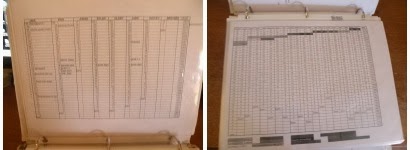
Then comes the plotting.  While I do the original plotting on a big white board, I like to have a portable copy I can take along or have at hand to look at as I write.  I also create a calendar that has the scene on the date it takes place (one page per month).  It helps me know how time is progressing throughout the story, and I don't have to hunt for how long it's been since something has happened...or will happen.
Small storyboard and Calendar of Scenes


Another handy tool is to have a calendar of a full year.  I found a great place online that has a printable calendar that goes back in time and goes forward a few years, too.  Another aid in plotting is a timeline, which comes in handy with the full year calendar when working through the story calendar.  The timeline includes time of day.  It helps when plotting forward to see if all makes sense, before using the monthly calendar.
Full year calendar and Timeline
I've always loved looking at house designs and house plans.  When many scenes will take place in a particular place, such as a house, I look for a plan that will suit my character.  Why?  Without a "map," I get lost and forget if the kitchen is to the left or the right, or even where the staircase is located.  It's like playing with a dollhouse on paper. ☺  Because the setting of the series is based on the layout of the area around the town where I spent my junior high and high school years, I pulled up Google Maps and have several aerial shots.  Three of the books in the series involve two brothers and a sister.  A little mini-series within a series.  The house of the hero in DESIGNS ON THE COWBOY (June 2013) is modeled after my great-aunt and great-uncle's house, a Victorian built in the late 1800s.  I had to go by memory on the inside, but for the farm/ranch, itself, an aerial view helped with the outbuildings, roads, and more.  This house and surrounding area play a big part in my upcoming August book (the sister), and a neighbor's house, which really isn't there.  I added squares of paper to show where the house, barn, a large pond, and other things were located on the hero's property.
House plan and photo, with aerial shot of the layout of the land
Last but not least for the August book, I kept getting myself turned around in the area around the hero's ranch house, so I created my own little map, so I would know what the characters would see and how they would get to where they were going. (on left)  The photo on the right is my working calendar.  I began it about halfway through the series.  It helps me keep on deadline and get things done when they need to be done to beat that deadline. ☺
Layout of ranch yard and My Working Calendar
All of the above--and sometimes more--are kept in protective sleeves in the front of the binder, now a story bible.  Behind them are tabs for each printed chapter.  Again, for portability.  I often work while waiting to pick up grandkids from school.  Nearly everything for writing the story is in the bible.  Some have more information from research I've done, most don't have aerials or ranch "maps."  If I think I might need something, I'll add it.  Pockets in front and back of the binder are handy for extras, such as scribbled notes or ideas for later.

For more information on Story Bibles, check out Taming the Series Beast on my author blog.  There are also links there for information on how other writers create their bibles.

So there it is.  My method of keeping track.  While I'd never dreamed of writing a 10-book series, the first two books grew into more new books, and I'm thankful I'd already begun to keep a bible for each book.  To keep all the major series information and a complete list of all characters (even those mentioned) and a complete age chart, who they are and what books they appear in, I use a 1/2" binder.

Remember, if you decide to create a story bible, do it your way.  Mine is only one of many.

Are you completely confused?  Overwhelmed?  That's okay.  It's done little by little.  For more details, you can give me a shout in the comments.  There are always little tricks to make it easier.

Oh, and HAPPY THANKSGIVING!!!  (We're having our turkey day tomorrow.)

What's the Point in a Goal?

First: What's a goal? It is a desired outcome.

Second: Why are they important? Because if a person, plant, or animal cannot muster up the candlepower of mental wattage to desire enough for an outcome, there is no need to bother breathing.

Last: What do we do with them? We work toward them. And I believe the best first step is to write them down.

Why? Because if you can think clearly enough to define a goal well enough to write it down, then your subconscious can help make your goal a reality. I have proof!

When I was in school, I watched as flurries of notes were passed about the next heartthrob and the comparisons thereof. Idiotic, I though it. After all, who can define love in fourth grade? Eighth grade? High school? I watched as those around me seemed to flitter here and there, defining their newest date as a love. From fourth grade on, I vowed never to tell anyone I loved them unless it were really true. No fly-by-wind-change love for me. Did I wish to date, kiss, carry on with a less than my true love? Of course. That I called dipping a toe in the lake of life. However, true love would have to wait for a true love in my heart.

But, I did dip a toe in the lake of life. And when I did, I discovered a banquet of options that I would need to choose from. I needed a list of likes and dislikes. By the time I was nineteen, I had noticed that people put more actual thought in the features of a stereo system or a car then in the loved one they hoped to acquire. This little issue I thought the height of, shall we call it foolhardy carelessness? So, in a cabin, high in the Rocky mountains, one day I made the list. Yes, a list of what I best required in a true loved spouse. A shopping list as it were. I still have that list. My husband has all but two requirements. He doesn't like to dance, although he can manage a bit. He isn't always a snappy dresser, although he is capable of it. The list was as simple as a height requirement (for ease of kissing). And as testing as the question about dogs. He had to interact with dogs well. For, I thought, if he does well with dogs, it will tell me how he will treat his wife and his children. I don't like dogs all that much. This was merely a test. He is wonderful with dogs. He can't help but play with them and likes to give them treats. I once watched him talk a huge, not-too-happy guard dog to his hand for petting. It took about twenty minutes, but was incredible to watch. He also likes to play and give treats to those he cares for. Does it get better? I'm spoiled.

What was that list? It was a goal. Did I refer to it often while dating? No. But my subconscious didn't let me stop looking until I found the guy who fit the list slipper. I repeated the same with my two daughters. There was a lot of eye-rolling, stubborn grumbling, and I think some under-the-breath name calling, but I made them put some thought one afternoon into completing a list. One had what I thought was out-of-the-box thinking that was likely to fail. And yet, her list did not fail her. She got what she wanted. Yes, she shed tears over other men, but when she found the one that fit the list, she stuck like a burr. Same with her sister. Not too long ago, I found their lists and sent them a copy, for fun, to show them how close they came. Their choices too, were almost spot on.

Is a goal important? Is it important to write it down? Obviously our answers are YES!!!

Lesser goals than personal happily-ever-after goals are also very useful. A few years ago, then WARA president Pat had us write out goals out for the year. I then lost the list for a while. It was a few months after the year was over I found the goal list. I had managed to meet many of them. Not that they were simple things--like getting dressed most days, no, they were writerly related. My subconscious had used the goals as a map that it used to make choices that led me to achieve better that year than any other.

Conclusion?
Write yer durn goals down!
Write down lesser goals that get you going the direction you feel you need to go!
Don't forget goals in other areas of your life as well. You're a well rounded person, right?
The time you spend writing down goals is NOT a waste of time. If you have the time, spend some time thinking about and listing lesser goals that will get you closer to the big goals. The big girls call that planning. I call it essential.

Tis the Season

Usually at this time of year I'd be going out of my mind with trying to remember what I know I must have forgotten. But not this year. This year, back in March, I signed on to get Flylady.net daily digests. At the time I thought I was being ridiculous because I couldn't find time to write so why would I add one more thing to do? But, I was working with my personal technology pets--this time an ipod. Ipods play music (mp3 downloads) as well as videos, movies, pictures--depending upon the model and the skill of the owner. I'm not skilled. I only bought the thing so I could listen to my Romance Writer's of America tapes from the 2004 conference. Yes, I know it is 2010. Didn't you notice I'm not skilled? Anyway, I bought the ipod--same model as my elder daughter so that she could talk me through any snags. She's good about helping and keeps reminding me that the internet is a wonderful thing. Google anything you need and there is likely to be a tutorial to learn the skill--I'm not kidding. I recently was looking up sewing machine models that would most likely have the power to mend jeans. There were jean mending tutorials all over the internet. Who knew? Oh, and did I also mention I have a hard time staying on topic?

I heard you roll your eyes.

Where was I? Oh, yea. The ipod and the conference tapes. I wanted to listen to the tapes in the car. The CDs would only work in the computer. When I'm at the computer I have other, more pressing things to do than listen to conference tapes. So, I downloaded them into the computer--that took a bit. Did you remember I'm not skilled? Then I managed to do the deed and get them on a cd to listen to in the car. Duh. Then I discovered that the 300hours of conference would need that many and more cds because they're only 80 minutes long. Craaaaap!. Again, my technology stuck its tongue out at me. I swear tech pets are like mules. They will refuse to cooperate and then suddenly do so when you least expect it. My wonderful friend's husband has two mules. They are worthless unless they are paid a lot of attention when THEY want it. On their off times they bite the bulls and annoy them. Oops. Off topic.

Again, I heard you roll your eyes...quit that!

Where was I? Oh, yea. So, I bought the ipod for the conference tapes. After hours of attempting to get the technomules to cooperate, I finally had the conference loaded into the ipod and then my ears got sore listening to the earbuds (why they are called earbuds I cannot conceive as I swear they were trying to do naughty things to my ears). Then, remember daughter one? She mentioned that if I had half a brain (Eureka! I do!!) I would install a transmitter to transmit the ipod sounds to the radio and listen in full comfort.

I purchased another techopet.

This one turned out to work easily and well...even for me.

I began to listen to the tapes which works out so very well since it is forty-five minutes one way to the bank or grocery store. Then. I listened to how to get more time to write. The writer recommended flylady.net. The principals found there help keep the real world from swallowing whole all the time you have for the writing world. It works.

My Christmas is not only on schedule, but I have time to pamper myself a little and find things I've been putting off getting done. Last week I was to have participated in a Book-in-a-week push. I had pledged five new pages. But I found something more, much more. I am now over my brain freeze on my work-in-progress (WIP). I edited and had such a good time with my story, I have nothing to show, but a grin. No new pages, but I fixed the devil out of the ones I had.

I have achieved a degree of calmness and best of all--hope. This next year is going to be one of the best I've had in a long time in my imaginary world of writing. I'm setting some serious goals. I haven't been as productive since our long ago, worthy president, Pat made us set goals. I was surprised at how many writerly goals I met that year. The thinking, selecting, and writing down of them caused them to be stored in the silent but working half of my brain. I'm setting goals for 2011. Professional goals. Technopet goals. (Yup, they're going to be trained or else.) Flylady.net has taught me how to get the most out of my time.

You may think this is an odd thing to write about at Christmas, but these experiences, work, goals, and opportunities, missed and taken, are also the things that make up a life and reasons to celebrate. Creating an eddy of calm in a fast-paced world so that I can create in writing is a great joy. So, I say, God bless my daughter, my technopets, google, and the author that steered me towards flylady.net. Oh, and while I'm at it. Have a very, very, merry Christmas with toasty warm toes and tight tummies from eating lots and lots of 'good stuff'!!

Carving out Time to Write


No matter what the stage of your writing career; no matter in what stage of life you are, finding time to write is difficult. I started writing when my children were three, five, and seven. Finding time meant 10 PM to 3 AM. I thought once they went to high school I’d have more time. Then it was when they left for college. They long ago established their own lives and I still have trouble carving out writing time. Now it’s my mother instead of my children. It’s health problems instead of different sports every night of the week. Life changes every day but the one constant is lack of time. Sometimes it’s like the graphic I’ve used to illustrate this post: Chisel five minute here, chisel fifteen minutes there. So what is a writer to do?

I offer a couple of basics that experience and research have corroborated for me.
1. Set your writing time at the top of the list of things to do. If it’s not important to you, it won’t get done. There will always be the lure of something else that needs done. Writing has to take precedence.

Does that mean you must do it first in your day to make sure it gets done? Not necessarily. You and your experience will answer that one. I suggest you follow your natural body rhythm. An early riser? Get up earlier than usual and write. A night owl? Carve your writing block there. Everyone’s day is different. Only you can know where best to take the time to write.

2. Organize your day so there is time. This is never easy. I seldom followed my written (who has time to write a plan you ask!) schedules exactly. Some days I wondered why I had ever bothered to think I could organize time with three kids in different school, teaching full time, wife, mother, chauffeur, etc. Murphy’s Law (What can go wrong, will) seemed to rule. But I found over the long haul that having a schedule and discipline helped. Sometimes we have to use tough love on ourselves. Email, blogs, Facebook and Twitter are all time gobblers. Set up boundaries for their use even if that means setting a timer. Also limit how many games of solitaire or spider solitaire or Free cell you play or if you play at all until page(s) are written. Tough love indeed when applied to ourselves but it will help carve out more writing time.

Writing success is 90% persistence. BITHOK—Butt in chair; Hands on keyboard. I make time for what is important to me. REALLY important. Family vies for time, the house vies for it, work gulps time, and all of these are important. But writing is a part of you. A part that demands expression and makes you whole.

Here are a few sites with some interesting perspectives on carving out writing time.
http://www.billiewilliams.com/CarvingOutWritingTime.html

http://lesbianauthors.wordpress.com/2009/09/06/carving-out-the-time-by-jove-belle/

http://www.christinaskye.com/writerscorner2.htm
http://thewildrosepress.com/publisher/index.php?option=com_content&task=view&id=132&Itemid=203

Please share with us the “tricks” you use to ferret out writing time in your day. Maybe one of them will help us “carve out” more writing time than we now do!