Showing posts with label Writing Problems. Show all posts

Writing. Difficult? Sometimes. by J Vincent


The hardest part of writing isn’t research.  Research is exciting and seductive.  I’ve been searching for the location of British HQ in Spain during the latter stages of the retreat to the Lines of Torres Vedras in 1810.  Each clue I come across fires excitement.  There is much to be said for the “hunt.”

The hardest part of writing isn’t deciding the setting--the where and when.  That’s pretty well set for me with the Napoleonic Wars.  It isn’t discovering the characters.  Discovering?” you ask?  That’s what it is like a lot of the time.  I had a perfectly vile villain who now in book four I learned actually had a heart.  Characters are like friends--you never know them completely and they can surprise you.

So what is the hardest part of writing?  Well, it’s the writing.  It’s the day to day sitting at the keyboard and hoping the words flow and forcing them (or trying to) when they won’t.  That usually isn’t good writing but a book will never get written if you don’t make yourself put words down one after another.  Some times the words gush so fast my fingers can’t keep up with them.  It’s like watching a movie and being a court reporter, afraid to miss anything.  Other days it’s similar to pulling pin feathers for those of you lucky enough to have had to “dress” chickens.  I never thought that an odd term until long after I stopped doing it.

Most days it’s a matter of just doing it.  Sit down, put the hands on the keyboard, and type.  If you’ve prepared well--that is, you’ve gotten to know your characters and you’ve plotted out the story--the words will come.  Perhaps not in a gush but with a steady enough flow.  If you are a “by the seat of your pants” writer as I am, you plot out the broad parameters of the story.  No, I’m not saying you only need to know that boy meets girl or vis a versa, girl gets boy and they live happily ever after.  I plot the different twists and turns of the story, though often I don’t know exactly what my characters are going to do.  Like recalcitrant children they often do their “own” thing.  I know the broad chapters and some of the scenes but not all.  So every now and then there is a hiccup of sorts where the action stalls.  At these times I try to just push the story forward.  I have learned that if I don’t take the right direction (right according to my hero/heroine) the story goes no where.  If that happens I simply backtrack and try again.  At this point you are probably wondering why I don’t plot out the entire book, scene for scene, like some writers do.  I’ve tried it and it just doesn’t work for me.  It uses up a lot of time as I throw out the outline from where my character deviated and rewrite it.  Over. And over.  Perhaps I’m just plot-challenged.  But different strokes for different folks, to use a trite, over-used expression. 

Different aspects of writing prove troublesome now and then but nothing is more rewarding than writing that final scene (there is no such thing as final in writing, only the last time--ask any writer if they won’t find something to change every time they look at one of their books!) and knowing you’ve created a story.  You’ve told a tale.  There isn’t anything better no matter what proved “difficult” on the way to The End.  
 How final is your writing?
 

Dousing myself with that well water from a surprising source (Melissa Robbins)


I have enjoyed reading fellow WARA members’ takes on this month’s timely topic.  I have to admit that some of my best ideas hit me while I’m in the shower.  Sitting on the ledge and dressed in his full RAF uniform, Connor pitched his story idea while I showered.  He probably relished the fact that I was naked, but he kept his remarks to himself. 

However, for the first two weeks of September, the showers failed me.  I struggled with my stories and word count (only 1000 words and that’s bad for me.)  Some experts say that your characters know their stories better than you and you should let them lead the way.  If I left Connor to his own devices, his story would make erotic romance read like a children’s book.  Quick!  Someone douse him with that well water.  On the FAR end of the spectrum is sweet and shy Carrick, my YA hero.  I know where I want him to go, but the settings stop me writing his story.  He isn't as loud as Connor either.  My poor Wren is stuck in the middle, wanting desperately for me to send out queries.  Just read my post on that subject!  Shiver. 

During Labor Day weekend, a friend and I experienced the insaneness of Dragon Con.  I hoped the time away from writing would refresh my well and I would come back ready to write.  See word count above.  Yeah, that didn’t happen.  Two weekends ago, I did not get up at 5 am during our first cold snap to write and chose to stay in my bed and snuggle with my warm husband. 

Soon after that, that same friend found a group wanting to do Steampunk costumes for next year’s DCon.  The idea sparked my creativity.  I love Steampunk and many of those costumes that have vintage military aspects.  I could incorporate many of the items from Connor and my stories since, of course, I would be a Steampunk pilot.  After sketching the costume all day, I woke up the next morning at 5 am and FINALLY figured out my Connor chapter I’ve been struggling with.  I moved on and wrote an 'almost kiss' scene, 700 words the first day, 600 words the next, and 400 after that. I finished that chapter yesterday.

So when you least expect it, that refreshing well may just appear out of nowhere and douse you with water.  Be ready.

Well Done

You can take the title of this blog post in a couple of ways:

The term "Well Done" can be praise for doing a good job at just about anything, such as, "This paper you turned in was well done."

It can also be a description of how something is cooked, as in, "How would you like that steak cooked?"  "Well done."

In my case at this point in time, my "Well Done" would be a combination of the two.  "This paper is cooked to a well done burnt crisp."

What does being burnt to a crisp have to do with refilling your creative well?  Anything and everything.

Everyone has heard the term Burned Out.  It can happen to anyone at any time.  As writers, we have our own special set of pressures.  For instance, to stay on deadline, whether that deadline is an individual choice we make or the decision of a publisher, as writers we quite often forget that there is something out there in addition to the "finish line."  We sometimes become so focused that we're consumed to the point of mental (and sometimes physical) exhaustion.

As women, we've been taught to be the nurturers.  The only problem with that is that, in the hustle and bustle of keeping a home, raising a family, and often working outside the home, the nurturing stops before it ever gets to us.  Who nurtures us?  Usually that falls to...us.  Add in being an artist---a person who creates, whether with words or paint or acting or clay or fabric...---and it doesn't take long for that well of creativity, that well of LIFE, to dry up.

From CNN article "Experts ponder link between creativity, mood disorders":
There have been more than 20 studies that suggest an increased rate of bipolar and depressive illnesses in highly creative people, says Kay Redfield Jamison, professor of psychiatry at Johns Hopkins University and author of the "An Unquiet Mind," a memoir of living with bipolar disorder.

I don't know about the rest of you, but that's kind of scary.  So what do we do about this?

We refill that well.  We take steps to return to sanity.  Not an easy task when it comes to hearing conversations of characters in our heads.

Refilling the well is simply taking a step back and away from the pressure we and others put on ourselves and us to create.  That step back can encompass something as big as a vacation or as small as listening to a favorite song.  Refilling the well is one of the most important things...that we ignore.

Where do we find information on refilling the well?

The Artist's Way by Julia Cameron is an excellent guide.  When talking about well refilling, this is one of the first guides that comes up in articles and conversation.  This 12-week course "in Discovering and Recovering Your Creative Self" takes time.  It can be worth it.

An excellent article to read is Filling the Well to Renew Our Creative Spirit at Womenfolk.com.  There are other articles there that are worth taking the time to read.

No time to read, but still in need of ideas?  Let's build a list of ways to Fill/Refill Our Well.  I'll start with these.  Feel free (please!) to add to it with your comments. :)


  • Listen to music - Whether one or two songs, an album, or an entire playlist, music can lift our spirits, calm our nerves, send restful vibes, or create ideas.
  • Dance - No, really.  Turn on the radio or any music that will get you on your feet and move.  It doesn't have to be for long.  A few minutes will get the blood circulating quicker, and produce endorphins.  
  • Yoga/Meditation - Yeah, really.  It's been found that 10 minutes of meditation can refresh both the mind and body.
  • Walking - Again, get the body moving.  Outside is best, if possible, because we get a dose of fresh air.  Try to make walking a habit.  It's not only good for the body, but good for the soul.
  • Watch a movie - We have a collection of over 400 movies on DVD.  I'm ashamed to count how many I haven't even opened, much less watched.  That doesn't mean I don't have my favorite feel-goods that I've watched more than twice.  This is one I need on my well-filling list!
  • Read a book - Not long ago, my reward for completing a big deadline was to read the latest book by Susan Elizabeth Phillips.  Reward yourself with a book by your favorite author.  It even beats Calgon. ☺
  • Take a mini-vacation - Sometimes we just need to get away.  My best friend from high school lives in my old hometown and, like me, is now single.  In the past, I've spent a weekend with her once or twice a year, and it's always been a refreshing break, even when I know that when I get home I'll have to buckle down and get busy again.  An overnight in a hotel/motel can also be a refreshing change and a great getaway from family, too.
  • Take an Artist Date - from the aforementioned Julia Cameron's The Artist's Way: "An artist date is a block of time, perhaps two hours weekly, especially set aside and committed to nurturing your creative consciousness, your inner artist.  In its most primary form, the artist date is an excursion, a play date that you preplan and defend against all interlopers."  An artist date is done alone.  Suggestions include visiting a junk shop, a museum, a park, a concert, and more.  These "dates" don't have to cost money.    Keep your eyes and ears open for opportunities.
  • For writing related activities to refill that well, try a WARA meeting.  Our retreats are especially great!  Or, if possible, attend a writers' conference.
There are many more ways to fill your well.  The trick is in doing them.  We're told all our lives that habits are bad.  Wrong!  Bad habits are bad.  Good habits are wonderful!  Sometimes even life-saving.  I'd like to be able to say that this next week, my refilling was well done, as in good job.  How about you?  

What will you do this week to refill your well?

Words on Paper (Penny Rader)

What is the most difficult or challenging part of the writing process for you?

For me the most difficult part is actually getting the words onto the page.  Because it’s so hard I resist it and do all sorts of things to avoid even trying.  Especially if I'm writing something someone else might read  – current wip, this blog post, stuff for my day job.

So often I just don’t know what to say.  Then the fear takes over.  What if I’m not really a writer? What if I never finish another book?  What if I sit down with my pen and notepad (or at the computer – though I struggle even more when it’s just me and the keyboard) and nothing comes out or I can’t get beyond the first few pages of this wip that has been waiting for me?  How many stories will I start and not finish? Say I get past chapter one or five…how will I know what’s supposed to come next? And then...what if it sucks big time?

I tell myself that I have written a book and that if I can complete one, then I can finish another.  If I share a secret, do you promise not to laugh at me?   I like “having it written,” but not the actual writing part.  I know!  Shameful thing for a writer to admit.

Want to hear something else?  Give me a picture or a writing prompt and I’ll get words on the page.  Give me some random words for our Mission Possible exercises and I can string them into a sentence.  I love writing exercises.  Maybe it’s because some of the pressure is off.  If I have a picture or prompt, I know what I’m writing toward.  But write a story just out of my head?  I guess the trick will be to find enough pictures, enough ‘prompts’ to plot out this current wip and get words on the page followed by more words and even more until I reach the end. And then I can edit and revise [which is one of my favorite parts of writing].  And then type “the end” and submit it to an editor.

And then I’ll have to start all over again.  That may be what truly scares me the most.

The Writing Process????

When I read the topic for this month I wondered if I wasn’t, well, uneducated.  As much as I hate to admit it I was rather puzzled by the question:  What is the most difficult or challenging part of the writing process for you?  At first I thought in general terms--Would it be problems in getting story ideas, doing research, plotting, getting words down on paper or what?  I wasn’t entirely sure what was meant by “the writing process.”
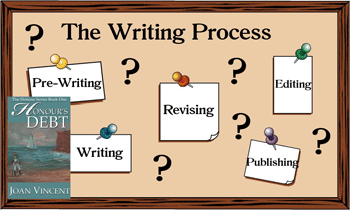
In today’s world when in doubt or ignorance, google.  It was with some relief I discovered I hadn’t missed the chalkboard completely.  As you can tell by the graphic above and if you check the links below there are five steps (more or less) to the writing process. Several of the sites offer help when you run into problems with the writing process.
 The ABC’s of the Writing Process  is an informative and entertaining site. 
Wikipedia  has an in-depth look at various approaches to the process. 
The Purdue online Writing Lab  has several helpful links for the process and troubleshooting when you get stalemated. 
Cleveland State University has a very pendantic approach which can be applied to romance writing although it is geared for thesis writing.

The Writing Process  1.  Prewriting  2.  Writing  3.  Revising  4.  Editing   5.  Publishing

I could say that publishing has been my problem of late since I’ve indie published Honour’s Debt.  But publishing is the endgame.  You have to have a completed manuscript before you can fret about getting it into print or digital formats.

Prewriting?  It is a mixed bag for me.  Research is a joy!  There is nothing like the chase for the right setting, time period, and details. 

Plotting?  Not so much, especially since I’m not conversant in using the terms Pat and Roz speak about so confidently and use so compellingly--plot points, black moments, character arcs, etc.  Perhaps it’s because I never knew another writer until after I was published.  Whatever the reason, I am definitely challenged in that area.  Thus I outline a story and my characters run away with it.  They leave me to muddle through their plot twists.  It is a writing weakness of mine that my stories come to me rather full blown.  When they don’t and I manufacture plot points I struggle to write the story.  Not a good thing for a fiction writer.

Revising?  Once I have the story’s first draft revising is no problem for me.  A former teacher, I just change my writing hat to an editing fedora and I’m good to go. 

Nothing has stymied me the past two years as much as a lack of writing persistence.  You’ve heard of it the solution--butt-in-chair-hands-on-keyboard.  A simple enough concept and yet I find myself yielding to the slightest distraction.  Free cell, helping my brother pick grapes in his vineyard, spider solitaire, sewing a quilt top for my niece, solitaire, playing with my grandchildren.  Huge sigh.  I do have two huge issues on my plate that are more than distracting but there was a time when even such serious problems didn’t stop my writing.  I’ve changed and the solutions I once employed to increase productivity no longer work.  I can’t seem to live with writing at the moment and I can’t live without it.  A conundrum but I’m certain there is an answer to it lurking in the shadows of my life.  Curiosity got the cat and it may get me through this slump.  I ask myself just how much good is in my monumentally bad guy Donatien?  I once thought there was none but he surprised me in Honour’s Redemption.  I have to write the next book to find out.  That will get my fingers moving.

Lastly some self promotion.  The Promise Rose, my Avalon book released in 2003, has just been released as an ebook by Regency Reads.